Microwave Radiometer Systems: Design and Analysis, Second Edition
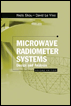
This book is the second edition of the book originally published in 1989. The reason for updating the book is twofold: Certain issues are outdated, and new developments and concepts have emerged.
Of course, all the basic principles and concepts are still valid, and parts of the chapters are largely unchanged from the first edition. However, when it comes to practical examples, like for example, the design of a spaceborne radiometer system, significant technology developments must be taken into account: A spaceborne radiometer will hardly still be assembled using individual waveguide components, but it will be implemented using Monolithic Microwave Integrated Circuit (MMIC) technology in order to save significantly on weight and bulk.
A completely new concept has also received considerable attention lately, namely, the polarimetric radiometer measuring the full Stokes vector. A new chapter, Chapter 7, is dedicated to this important new technique. Most importantly, the synthetic aperture also called interferometric radiometer has been developed for Earth remote sensing. This is indeed a very interesting and important new technique that does a lot towards solving the problem associated with high-resolution imaging, especially at low microwave frequencies requiring large antenna apertures.
This book describes many years of work with microwave radiometers and radiometer systems. It concentrates very much on practical experiences and how to do it, not on the theoretical backgrounds. It is assumed that the reader is familiar with the basics of radiometry to a level comparable with that given in [1]. Actually, this book may be seen as a...