Microwave Radiometer Systems: Design and Analysis, Second Edition
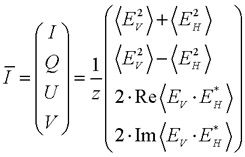
Generally, the radiation from an object is partly polarized, meaning that the brightness temperature at vertical polarization T V is different from the brightness temperature at horizontal polarization T H. A well-known example is the sea surface. To describe scenes with partial polarization, it is convenient to use the Stokes parameters. The Stokes vector is:
| (7.1) | |
where z is the impedance of the medium in which the wave propagates. It is seen that I represents the total power, Q represents the difference of the vertical and horizontal power components, and U and V represent, respectively, the real and imaginary parts of the cross correlation of the electrical fields.
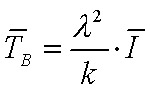
Assuming that the Rayleigh-Jeans approximation is valid for signals in the microwave regime, the Stokes vector for the fields in (7.1) can be converted to an equivalent brightness temperature Stokes vector:
| (7.2) | |
where ? is the wavelength and k is Boltzmann's constant. The parameters of T B are termed I B, Q B, U B, and V B where
and so on. It can be shown that:
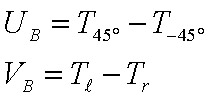
| (7.3) | |
where T 45 and T -45 represent orthogonal measurements rotated 45 with respect to the reference directions for V and H polarizations, and T ? and T r refer to left-hand and right-hand circular polarized quantities. It is common in the radiometer literature to use the notations I