Microwave Radiometer Systems: Design and Analysis, Second Edition

13.4: Antenna Design

13.4 Antenna Design

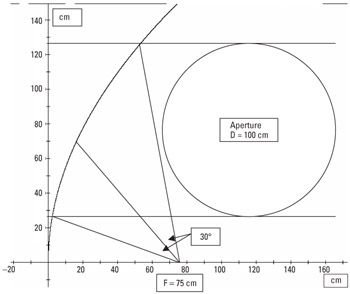
Only a few comments shall be brought forward for the sake of completeness, the subject being outside the scope of this book. The general antenna geometry is shown in Figure 13.4. The geometry is equivalent to the one shown in Figure 11.4, with a 50 offset angle.


Figure 13.4: Antenna geometry.

The reflector has a 100-cm circular aperture and the focal length is 75 cm. The antenna term: "F/D ratio" is 0.30 (note that in this context D is not the aperture but the total diameter of the paraboloid from which the offset section may be cut out). The total dimensions of the reflector are 100 112 cm. The feed axis is tilted 50 with respect to the parabola axis.

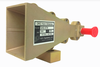
Typical Potter horns are assumed at the lower frequencies, and multiflare horns at 89 GHz. The Potter and the multiflare horns are light, compact designs with very thin walls (hence little difference between inner and outer diameter of the horn aperture). Table 13.10 shows the outer diameter of the horn apertures for a set of Potter/multiflare horns.

Table 13.10: Horn Dimensions

F(GHz)

d(mm)

10.65

88

18.7

50

23.8

40

36.5

27

89.0

11

The offset reflector is scaled for an illumination angle of 30 . At this angle the typical horn patterns are down by 20 21 dB. Adding roughly a 1-dB space attenuation results in an edge illumination of the reflector in the -21- to -22-dB range, meaning that the factor 1.4 in the beamwidth...

UNLIMITED FREE
ACCESS
TO THE WORLD'S BEST IDEAS

SUBMIT
Already a GlobalSpec user? Log in.

This is embarrasing...

An error occurred while processing the form. Please try again in a few minutes.

Customize Your GlobalSpec Experience

Category: Horn Antennas
Finish!
Privacy Policy

This is embarrasing...

An error occurred while processing the form. Please try again in a few minutes.