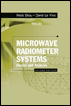
Microwave Radiometer Systems: Design and Analysis, Second Edition
Chapter 4: Radiometer Principles

The extremely simplified block diagram of a radiometer, as displayed in Figure 3.3, will in this chapter be somewhat elaborated as a first step towards a full block diagram to be discussed in later sections. Some of the principles used to avoid degradation of accuracy due to gain and noise temperature instabilities will be worked through.

4.1 The Total Power Radiometer (TPR)

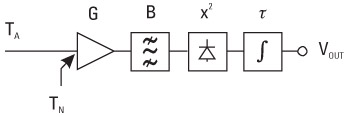
In principle we are still talking about the same radiometer as discussed in Chapter 3, but the block diagram has been expanded in Figure 4.1, to explain better the function of the radiometer. The gain in the radiometer has been symbolized by an amplifier with a gain G, and the frequency selectivity has been symbolized by a filter with a bandwidth B (centered around some given frequency). The microwave power has to be detected to find some measure of its mean. Two straightforward detector types can be made, using microwave semiconductor diodes: the linear detector and the square-law detector. In the present case, it is very attractive to use the square-law detector. Then the output voltage will be proportional to the input power and hence the input temperature. Finally, we indicate where the integration takes place: The signal from the detector is smoothed by the integrator to reduce fluctuations in the output, and the longer the integration time, the more smoothing there is.


Figure 4.1: Total power radiometer.

The output can be expressed as:

(4.1)

where c is a constant. V OUT is totally...

UNLIMITED FREE
ACCESS
TO THE WORLD'S BEST IDEAS

SUBMIT
Already a GlobalSpec user? Log in.

This is embarrasing...

An error occurred while processing the form. Please try again in a few minutes.

Customize Your GlobalSpec Experience

Category: Radiometers
Finish!
Privacy Policy

This is embarrasing...

An error occurred while processing the form. Please try again in a few minutes.