Microwave Radiometer Systems: Design and Analysis, Second Edition
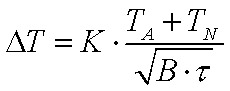
The sensitivity of a microwave radiometer is generally expressed as
where:
T A = antenna temperature
T N = receiver noise temperature
B = predetection bandwidth
? = integration time
The value of K is dependent on the radiometer type in question, and the value is generally 1 for total power radiometers and 2 for Dicke type switching radiometers. It is clear that the total power radiometers have much better sensitivity than the Dicke type of radiometers. However, regarding stability, total power radiometers are inferior to the other types. Stability is difficult to predict.
For a spaceborne radiometer, certain constraints affect the choice of parameters and hence the sensitivity achievable: ? is limited by mission requirements to swath width and footprint size; B is limited due to fear of interference from external sources; and T N is limited by available technology. Hence, there is great interest in the potentially better sensitivity of total power radiometers for certain applications, where sensitivity requirements are severe.
The total power radiometer is simpler than the other types. It does not include the Dicke switch and the synchronous detector found in the Dicke type of receiver, and it certainly does not include the noise-injection circuitry found only in the noise-injection radiometer. Hence, a total power radiometer is smaller, lighter, and may consume less power than other radiometer types.
However, this radiometer type can of course only find use for a given application if the accuracy and...