Microwave Radiometer Systems: Design and Analysis, Second Edition
Chapter 11: Radiometer Antennas and Real Aperture Imaging Considerations

The purpose of the antenna is to collect the emitted energy from a target and present it to the radiometer input.

11.1 Beam Efficiency and Losses

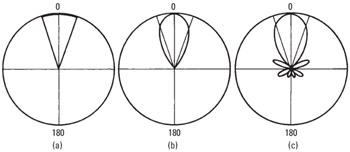
The ideal antenna has a certain gain within its field of view and zero gain outside. Figure 11.1(a) shows the polar pattern for such an idealized antenna. The measurement situation becomes very simple: If an extended target is viewed by the antenna, this collects energy from the target and not from anything else in the world. However, such an antenna cannot be realized. First, the sharp cutoff of the beam is not possible. Figure 11.1(b) shows a more realistic beam. To define the beamwidth, it is now necessary to refer to a certain level on the beam compared to the peak gain. The -3-dB points are normally used. Actually even this pattern is not possible in real life. Sidelobes picking up energy from directions far away from the main beam direction cannot be avoided [see Figure 11.1(c)]. By careful design they can be minimized but never avoided.


Figure 11.1: Antenna polar patterns (a) idealized sector shape, (b) realistic main beam, and (c) realistic pattern.

An important antenna property is the so-called beam efficiency ? defined as the ratio between the energy received through the main beam and the total energy received by the antenna (main beam + all sidelobes). The antenna in Figure 11.1(a) has a beam efficiency of 100%. To fully describe the beam efficiency for a realistic pattern, ? is...

UNLIMITED FREE
ACCESS
TO THE WORLD'S BEST IDEAS

SUBMIT
Already a GlobalSpec user? Log in.

This is embarrasing...

An error occurred while processing the form. Please try again in a few minutes.

Customize Your GlobalSpec Experience

Category: Horn Antennas
Finish!
Privacy Policy

This is embarrasing...

An error occurred while processing the form. Please try again in a few minutes.