|
|
||
|
Product Alerts
Keep current on the latest products, new suppliers, and technical articles of interest to you. (See Topics) |
|
From Transceiver and System Design for Digital Communications, Second Edition
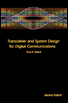
The receiver is responsible for downconverting, demodulating, decoding, and unformatting the data that is received over the link with the required sensitivity and bit error rate according to the link budget analysis of Chapter 1. The receiver provides the dynamic range to cover the expected range and power variations as well as the sensitivity for low level signals and prevent saturation from larger power inputs. In addition, the receiver detects and synchronizes the incoming signals to retrieve the data that was sent by the transmitter. The receiver section is also responsible for despreading the signal when spread spectrum signals are used. 3.1 Superheterodyne ReceiverThe main function of the receiver is to take the smallest input signal, i.e., the minimum discernable signal (MDS) at the input of the receiver and amplify that signal to the minimum discernable signal at the A/D converter while maintaining a maximum possible S/N ratio (SNR). A typical block diagram of a receiver is shown in Figure 3-1. Most receivers are referred to as superheterodyne receivers which means that they use a common inter-mediate frequency (IF) and two stages to downconvert the signal to base-band, as shown in Figure 3-1. Figure 3-1: Typical superheterodyne receiver. This type of receiver is used for the following reasons:
Copyright Noble Publishing Corporation 2000 under license agreement with Books24x7
Products & Services
Spectrum analyzers and signal analyzers display raw, unprocessed signal information such as voltage, power, period, wave shape, sidebands, and frequency. They can provide the user with a clear and precise window into the frequency spectrum.
Search by Specification |
Learn more about Spectrum Analyzers and Signal Analyzers
RF mixers convert RF power at one frequency into power at another frequency to make signal processing easier and more efficient.
Search by Specification |
Learn more about RF Mixers
Radio receiver ICs support worldwide radio band requirements, including frequency modulation (FM), FM radio data system (RDS), amplitude modulation (AM), long wave (LW), short wave (SW), and weather bands.
Learn more about Radio Receiver ICs
S meters (strength meters, signal-strength meters) measure the strength of signals in communication systems such as receivers and transmitters.
Learn more about S Meters
RF receivers are electronic devices that enable a particular radio signal to be separated from all others being received and converted into a format for video, voice, or data.
Search by Specification |
Learn more about RF Receivers
Product Announcements
Topics of Interest
Automatic gain control (AGC) is used in a receiver to vary the gain in order to increase the dynamic range of the system. AGC also helps to deliver a constant amplitude signal to the detectors with...
(Read More)
Overview
Low-priced shortwave receivers often suffer from performance problems that are a direct result of the trade-offs that the manufacturers make to produce a low-cost model. In addition, older...
(Read More)
David B. Hallock
This chapter will present the results of the evolution of receiver design with emphasis on the circuits, components, and techniques that are important for SSB reception.
4.1...
(Read More)
Chapter Introduction
From cellular phones to two-way pagers to wireless Internet access, the world is becoming more connected, even though wirelessly. No matter the technology, these devices are...
(Read More)
Without a solid understanding of the complete communications system all the way from the transmitter s modulator input to the receiver s demodulator output including everything in between and how the...
(Read More)
|
|