Transceiver and System Design for Digital Communications, Second Edition
Chapter 1: Transceiver Design

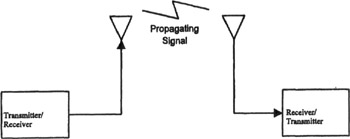
A transceiver is a system that contains both a transmitter and a receiver. The transmitter from one transceiver sends a signal through space to the receiver of another transceiver in a communications link system as shown in Figure 1-1.

Proper transceiver design is critical in view of the cost and performance of a data link. In order to provide the optimal design for the transceiver, a link budget is used to allocate the gains and losses in the link.


Figure 1-1: The transceiver block diagram.

1.1 Frequency of Operation

In a transceiver design, we commonly first determine the RF frequency of operation. The frequency of operation depends on the following factors:

  1. RF frequency availability This is the frequency band that is available for use by a particular system and is specified by the Federal Communications Commission (FCC), which has the ultimate control over the frequency band allocation.

  2. Cost As the frequency increases, the components in the receiver tend to be more expensive. An exception to the rule is when there is a widely used frequency band, such as with the cellular radio band, where supply and demand drives down the cost of parts and where integrated circuits are designed for specific applications. These circuits are known as application specific integrated circuits or ASICs.

  3. Size and range As a general rule, decreasing the frequency will also decrease the free-space attenuation, which results in an increase in range for line-of-sight applications and a lower power output requirement which would...

UNLIMITED FREE
ACCESS
TO THE WORLD'S BEST IDEAS

SUBMIT
Already a GlobalSpec user? Log in.

This is embarrasing...

An error occurred while processing the form. Please try again in a few minutes.

Customize Your GlobalSpec Experience

Category: RF and Wireless Chips
Finish!
Privacy Policy

This is embarrasing...

An error occurred while processing the form. Please try again in a few minutes.