Transceiver and System Design for Digital Communications, Second Edition
This chapter provides an overview of theory necessary for the design of digital communication systems. Simple probability theory analysis, pulse analysis in both the time and frequency domain, and probability of error will be discussed.
Understanding probability is the key to designing digital communication systems and spread spectrum systems. Probability is used in the link budget calculations in regards to the error and required S/N ratio, as well as to determine whether a transceiver is going to work and at what distances.
The central question concerning probability is whether something is going to occur, whether it be an error in the system or the probability that multipath will prevent the signal from arriving at the receiver. The probability that an event occurs is described by the probability density function (PDF) and is defined as
Probability can be expressed as a percentage, for example, a 10 percent chance that a value is present or that an event has occurred. The integral of the density function equals 1, i.e., the entire density function adds up to 100 percent.
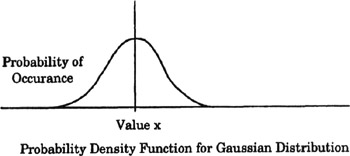
For example, if there is a 10 percent chance of getting it right, by default there is a 90 percent chance of getting it wrong. The PDF curve shows the probability of occurrence (see Figure 6-1).
Often this curve is mislabeled as the distribution curve instead of the density curve. Figure 6-1 shows...