Transceiver and System Design for Digital Communications, Second Edition
1.6: Receiver

1.6 Receiver

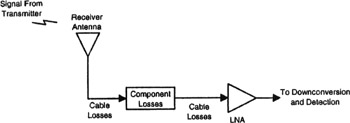
The receiver accepts the signal that was sent by the transmitter through the channel via the receiver antenna (see Figure 1-4). The losses from the antenna to the low noise amplifier (LNA) should be kept as small as possible. This includes cable losses and component losses that are between the antenna and the LNA (see Figure 1-4). The distance from the receiver antenna and the LNA should be kept as small as possible. Some systems actually include the LNA with the antenna system, separate from the rest of the receiver, to minimize this loss. The main job of the receiver is to receive the transmitted signal and detect the data that it carriers in the most effective way without further degrading the signal.


Figure 1-4: The receiver block diagram.

Receiver Antenna Losses

There are antenna losses for the receiver that are very similar to those for the transmitter. Some of the commonly occurring losses are listed here.

  1. L rr = radome losses on receiver antenna. The radome is the covering over the antenna to protect the antenna from the outside elements, which can cause losses.

  2. L rpol = polarization loss of receiver. Many antennas are polarized, horizontal, vertical, or circular. This defines the spacial position or orientation of the electric and the magnetic fields. A loss is realized due to polarization.

  3. L rcon = conscan cross over loss. This loss is present if the antenna is scanned in a circular search pattern.

  4. L rfoc

UNLIMITED FREE
ACCESS
TO THE WORLD'S BEST IDEAS

SUBMIT
Already a GlobalSpec user? Log in.

This is embarrasing...

An error occurred while processing the form. Please try again in a few minutes.

Customize Your GlobalSpec Experience

Category: Antennas
Finish!
Privacy Policy

This is embarrasing...

An error occurred while processing the form. Please try again in a few minutes.