Transceiver and System Design for Digital Communications, Second Edition
The term dB is the abbreviation for decibels. The main reason that dB is used is to enable the engineer to calculate the resultant power level by simply adding or subtracting gains and losses instead of multiplying and dividing. For example,
Amplifier input = 150 ?W = ?8.2 dBm
Amplifier power gain = 13 = 11.14 dB
Power output = 150 ?W 13 = 1.95 mW = 2.9 dBm
Power output in dB = ?8.2 dBm + 11.14 dB = 2.9 dBm = 1.95 mW
The term dB is used in the industry extensively and it has been wrongly used in many cases. To clear up some misunderstanding, the following is an explanation of different dB terms:
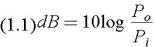
The term dB is a change in signal level, signal amplification or signal attenuation. It is the ratio of power output to power input. It can also be the difference from a given power level such as, "so many dB down from a reference." The equation is
where
| P o | = power out, |
| P i | = power in. |
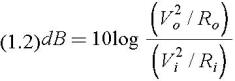
For voltage, the same equation is used substituting V 2/ R for P:
where
| V o | = voltage out, |
| V i | = voltage in, |
| R o | = output impedance, |
| R i | = input impedance. |
If R o = R i, then
Often dB, which is a ratio of powers, is mistakenly used in place of dBw, which is actually a...