Transceiver and System Design for Digital Communications, Second Edition
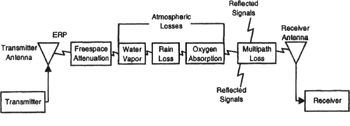
The channel is the path of the RF signal that is transmitted from the transmitter antenna and received by the receiver antenna (see Figure 1-1). This is the signal in space that is attenuated by the channel medium. The main contributor to the channel loss is known as the freespace attenuation. The other factors including the propagation losses and the multipath losses, are fairly small compared to freespace loss. The losses are depicted in Figure 1-3.
As a wave propagates through space, there is a loss associated with it. This loss is due to dispersion, the "spreading out" of the beam of radio energy as it propagates through space. This loss is consistent relative to wavelength, which means that it increases with frequency as the wavelength becomes shorter. This is called free space loss or path loss and is related to both the frequency and the slant range, the distance between the transmitter and receiver antennas. The equation is given by
where
| ? | = wavelength, |
| R | = slant range (same units as ?) |
| c | = speed of light, 300 106 meters/sec, ( R is in meters), |
| f | = frequency. |
At first glance, the free-space loss appears to decrease as the range increases; however, as the number inside the brackets gets smaller and is less than one, the resultant becomes a larger negative number. Therefore, the free-space loss increases as both the range and the frequency increase.