Transceiver and System Design for Digital Communications, Second Edition
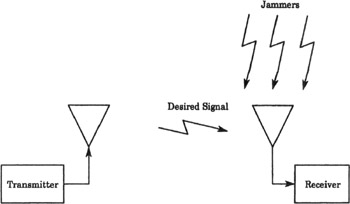
The type of jammer that will prevent communications and the means to eliminate or reduce the effects on the reception of the desired signal are crucial to most systems. The receiver is open to reception of not only the desired signal, but all jammers that are within the receiver's bandwidth (see Figure 8-1), which can prevent the receiver from processing the desired signal properly. This chapter discusses in detail three solutions on how to reduce the effects of jammers. A method to protect the system against pulse or burst jammers, an adaptive filter to reduce narrow band jammers, such as CW, and a jammer reduction technique called a Gram-Schmidt Orthogonalizer (GSO). Moreover, in some systems, the ability for another receiver to detect the desired signal is important in the design.
One of the best jammers for direct sequence spread spectrum modulation is a burst jammer. A burst jammer is generally a high amplitude narrowband signal relative to the desired signal, which is present for a short period of time. Typical bursts range from 0-40 dB jammer-to-signal ratio (J/S), with a duration from 0.5-1000 ? s. An example of a burst jammer is shown in Figure 8-2.
The burst jammer affects the receiver as follows:
The high amplitude of the burst saturates the automatic gain control (AGC) amplifiers, detectors and the processor. The information is...