Transceiver and System Design for Digital Communications, Second Edition
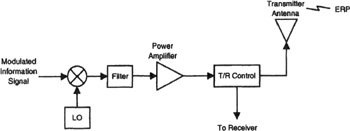
The transmitter is responsible for formatting, encoding, modulating and upconverting the data that is transmitted over the link with the required power output according to the link budget analysis. The transmitter section is also responsible for spreading the signal using various spread spectrum techniques. Several spread spectrum waveforms are discussed in this chapter. The primary types of spread spectrum using direct sequence methods to phase-modulate a carrier are discussed in detail including diagrams and possible design solutions. A block diagram of the basis components of a typical transmitter is shown in Figure 2-1.
The antenna receives the RF signal from the power amplifier and translates this RF power into electromagnetic waves so that the signal can be propagated through the air. The antenna is dependent on the frequency of the RF and the specified operational requirements. The proper design of the antenna ensures that the maximum signal power is sent out in the direction of the receiver or in the required service volume. The gain of the antenna improves the link budget on a one for one basis. That is, for every dB of gain the antenna exhibits, the link is improved by a dB. Therefore, careful design of the antenna can reduce the power output required from the power amplifier, which reduces cost of the system. The frequency, amount of gain required, and size, are factors in determining the type of antenna to be used. Parabolic dishes are used frequently...