
1300 nm Fiber Optic Couplers
Last Updated: April 1, 2025
Description
1300 nm Fiber Optic Couplers are devices used in fiber optic systems to manage light signals. They are designed to either split optical signals into multiple paths or combine multiple signals into a single path. These couplers are essential components in optical networks, enabling the efficient distribution and routing of light signals.
Working Principle
Fiber optic couplers operate by manipulating the flow of light within optical fibers. They utilize the principle of light splitting and combining, where the optical signal, composed of photons, is divided among multiple output ports. This division is necessary because, unlike electrical signals, optical signals do not flow through a receiver to the ground. Instead, they are absorbed by detectors. The couplers are characterized by their N M configuration, where N represents the number of input fibers and M the number of output fibers. This configuration allows for the precise control of signal distribution, making them invaluable in complex optical networks.
Applications
1300 nm Fiber Optic Couplers are widely used in various applications, including wavelength-division multiplexing and demultiplexing. These applications involve the separation and combination of light beams at different wavelengths, such as 1310 nm and 1550 nm, to optimize the transmission of data over optical fibers. They are also used in fiber optic sensing and polarization splitting, which are critical in telecommunications and data transmission systems.
Advantages over other Fiber Optic Couplers
One of the significant advantages of 1300 nm Fiber Optic Couplers is their ability to handle specific wavelength ranges effectively, such as the 1310 nm band. This capability makes them particularly useful in applications requiring precise wavelength management, such as wavelength-division multiplexing. Additionally, their design allows for efficient signal splitting and combining, which is crucial for maintaining signal integrity in complex optical networks.
Limitations
A limitation of fiber optic couplers, including those operating at 1300 nm, is their inherent insertion loss. This loss occurs because the signal is divided among multiple output ports, reducing its magnitude. This can impact the overall efficiency of the optical network, requiring careful consideration during system design to mitigate signal degradation.
Considerations
When considering the use of 1300 nm Fiber Optic Couplers, several factors should be taken into account. Initial costs can vary depending on the complexity and configuration of the coupler. Operating expenses may include maintenance and potential replacement costs due to wear and tear over time. Durability and accuracy are also critical, as these factors influence the long-term performance and reliability of the optical network. Regular maintenance and calibration may be necessary to ensure optimal functionality and to minimize the impact of insertion loss on signal quality.

from Megladon Manufacturing Group, Ltd.
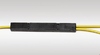
MM Couplers\Splitters. Megladon Couplers and Splitters are custom built to our customers specifications. We are capable of any coupling ratio from 50:50 to 99:1, build bi-directional assemblies, and utilize our HLC processed connectors for the lowest insertion loss performance. We build metal tube,... [See More]
- Wavelength: 1300 nm; 850 and 1310
- Input Ports: 2
- Cable Type: Multimode
- Output Ports: 2
from Microwave Photonic Systems, Inc.
The MPS-2300 Singlemode Optical Splitter/Coupler is available in a variety of configurations and split ratios to meet your specifications. The MPS-2300 can be ordered with either single window or dual window wavelength capability. The single window units are centered on either 1310nm or 1550nm... [See More]
- Wavelength: 1300 nm; 1550 nm
- Coupler Type: Single Window; Dual Window
- Cable Type: Single Mode
- Input Ports: 1
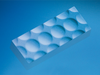
from Axetris AG
Axetris fiber micro-lens arrays are optimized for coupling light efficiently to single mode fiber arrays for optical communication applications. Features. Applications. Small size. Low insertion loss. Fused Silica or Silicon material. Low surface roughness. 100 % inspection. Parallel channel... [See More]
- Wavelength: 1300 nm; 1550 nm; 1260-1620 nm
- Insertion Loss: 1
- Cable Type: Single Mode
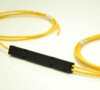
from Megladon Manufacturing Group, Ltd.
SM Couplers\Splitters. Megladon Couplers and Splitters are custom built to our customers specifications. We are capable of any coupling ratio from 50:50 to 99:1, build bi-directional assemblies, and utilize our HLC processed connectors for the lowest insertion loss performance. We build metal tube,... [See More]
- Wavelength: 1300 nm; 1550 nm
- Input Ports: 1
- Cable Type: Single Mode / Multimode
- Output Ports: 2
from Microwave Photonic Systems, Inc.
The MPS-2300 Singlemode Optical Splitter/Coupler is available in a variety of configurations and split ratios to meet your specifications. The MPS-2300 can be ordered with either single window or dual window wavelength capability. The single window units are centered on either 1310nm or 1550nm... [See More]
- Wavelength: 1300 nm; 1550 nm
- Coupler Type: Single Window; Dual Window
- Cable Type: Single Mode
- Input Ports: 2