
Single Mode / Multimode Fiber Optic Couplers
Last Updated: April 1, 2025
Description
Single Mode and Multimode Fiber Optic Couplers are devices used in fiber optic systems to either split optical signals into multiple paths or combine multiple signals into a single path. These couplers are integral components in managing the flow of light within fiber optic networks, facilitating the distribution and combination of optical signals.
Working Principle
Fiber optic couplers operate by manipulating the flow of light within optical fibers. They can either split a single optical signal into multiple outputs or combine multiple optical signals into a single output. This is achieved through the use of passive components that do not require an external energy source. The couplers are characterized by their N M configuration, where N represents the number of input fibers and M represents the number of output fibers. This configuration allows for the division or combination of optical signals, making them essential for efficient signal management in fiber optic systems .
Applications
Fiber optic couplers are widely used in various applications, including wavelength-division multiplexing and demultiplexing. For instance, in an erbium-doped fiber amplifier, a coupler can be used to manage light beams at different wavelengths, directing them to specific ports based on their wavelength. This capability is crucial in applications where precise control over signal routing is required .
Advantages over other Fiber Optic Couplers
Single Mode and Multimode Fiber Optic Couplers offer specific advantages in terms of their ability to handle different modes of light propagation. Single mode fibers, for example, allow only one mode of light to propagate, which is beneficial for high-speed, long-distance communication links. This precision in light propagation can result in lower signal loss and higher efficiency compared to other types of couplers .
Limitations
One limitation of fiber optic couplers is their inherent signal loss due to the division of optical signals among multiple output ports. This reduction in signal magnitude can affect the overall performance of the fiber optic system, particularly in applications requiring high signal integrity .
Considerations
When selecting fiber optic couplers, several factors should be considered, including initial costs, operating expenses, durability, accuracy, and maintenance costs. The choice between single mode and multimode couplers will depend on the specific requirements of the application, such as the distance of signal transmission and the need for precision in signal routing. Additionally, the configuration of the coupler (e.g., 2x2, 4x4) should align with the network's design to ensure optimal performance .
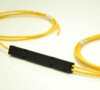
from Megladon Manufacturing Group, Ltd.
SM Couplers\Splitters. Megladon Couplers and Splitters are custom built to our customers specifications. We are capable of any coupling ratio from 50:50 to 99:1, build bi-directional assemblies, and utilize our HLC processed connectors for the lowest insertion loss performance. We build metal tube,... [See More]
- Cable Type: Single Mode / Multimode
- Input Ports: 1
- Wavelength: 1300 nm; 1550 nm
- Output Ports: 2

from Tripp Lite by Eaton
This coupler provides a simple and easy way to link together two fiber optic cables with SC connectors. Can be used with duplex or simplex cable assemblies. Supports all Multimode versions ( OM1, OM2, OM3, and OM4 ), as well as Singlemode. Features. Dual SC female connectors. For 62.5/125, 50/125... [See More]
- Cable Type: Single Mode / Multimode
- Coupler Connector: SC DUPLEX (FEMALE)
from OFS
Polarization-Maintaining Power Combiners couple 6 multimode high-power sources and 1 polarization-maintaining (PM) source for combined power output or for use with a PM cladding pumped fiber. [See More]
- Cable Type: Single Mode / Multimode
- Wavelength: 980 nm
- Coupler Type: Wideband
- Input Ports: 6