
Single Window Fiber Optic Couplers
Last Updated: April 1, 2025
Description
Single Window Fiber Optic Couplers are devices used in fiber optic systems to split or combine optical signals. They are designed to manage optical signals within a specific wavelength range, ensuring efficient signal routing and distribution within fiber optic networks.
Working Principle
Single Window Fiber Optic Couplers operate by either splitting an optical signal into multiple paths or combining multiple signals into a single path. This is achieved through the use of multiple input and output ports, characterized by an N M configuration, where N represents the number of input fibers and M represents the number of output fibers. The couplers are designed to handle specific frequency bands to avoid absorption bands within the optical fiber, ensuring minimal signal loss and efficient signal management.
Applications
Single Window Fiber Optic Couplers are crucial in applications such as wavelength-division multiplexing and demultiplexing. For instance, they can be used in erbium-doped fiber amplifiers to manage signals at different wavelengths, such as 980 nm and 1550 nm, directing them to different ports for efficient signal processing and amplification.
Advantages over other Fiber Optic Couplers
Single Window Fiber Optic Couplers offer the advantage of precise wavelength management, which is essential in applications requiring specific wavelength handling, such as in wavelength-division multiplexing. This specificity allows for more efficient signal routing and reduced signal loss compared to couplers that handle broader wavelength ranges.
Limitations
One limitation of Single Window Fiber Optic Couplers is their wavelength specificity, which can restrict their use to applications within a particular wavelength range. This can limit their versatility in systems that require handling multiple or varying wavelengths.
Considerations
When considering Single Window Fiber Optic Couplers, it is important to evaluate initial costs, which can vary based on the complexity and configuration of the coupler. Operating expenses are generally low, but durability and accuracy are critical factors, as these couplers must maintain precise wavelength management over time. Replacement and maintenance costs should also be considered, as these can impact the long-term cost-effectiveness of the system.
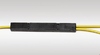
from Microwave Photonic Systems, Inc.
The MPS-2350 Multimode Optical Splitter/Coupler is available in a variety of configurations and split ratios to meet your specifications. The MPS-2350 can be ordered with any of the following operating wavelengths: 630,850,1310 and 1550nm. Fiber pigtail configurations include 250 µm, 900... [See More]
- Coupler Type: Single Window; Dual Window
- Wavelength: 633 nm (optional feature); 830 nm (optional feature); 1300 nm (optional feature); 1550 nm (optional feature)
- Cable Type: Multimode
- Input Ports: 1

from Corning Optical Communications
Corning's optical couplers are fused fiber branching devices that split off a portion of light to allow for optical monitoring and feedback. These devices are used extensively in fiber amplifier power control, and in transmission equipment for performance monitoring and feedback control. Our... [See More]
- Coupler Type: Single Window; Dual Window
- Wavelength: 1550 nm; Single Window - 1310 ±40 nm, 1528-1563 nm, 1550 ±40 nm, or 1528-1605 nm; Dual Window - 1310/1550 ±40 nm
- Cable Type: Single Mode
- Input Ports: 1
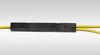
from Microwave Photonic Systems, Inc.
The MPS-2350 Multimode Optical Splitter/Coupler is available in a variety of configurations and split ratios to meet your specifications. The MPS-2350 can be ordered with any of the following operating wavelengths: 630,850,1310 and 1550nm. Fiber pigtail configurations include 250 µm, 900... [See More]
- Coupler Type: Single Window; Dual Window
- Wavelength: 633 nm (optional feature); 830 nm (optional feature); 1300 nm (optional feature); 1550 nm (optional feature)
- Cable Type: Multimode
- Input Ports: 1
from Microwave Photonic Systems, Inc.
The MPS-2300 Singlemode Optical Splitter/Coupler is available in a variety of configurations and split ratios to meet your specifications. The MPS-2300 can be ordered with either single window or dual window wavelength capability. The single window units are centered on either 1310nm or 1550nm... [See More]
- Coupler Type: Single Window; Dual Window
- Wavelength: 1300 nm; 1550 nm
- Cable Type: Single Mode
- Input Ports: 2