
Firewire® (IEEE 1394) Network Cards and Network Controllers
Last Updated: April 1, 2025
Description
FireWire® (IEEE 1394) network cards and network controllers are devices that facilitate the transmission of digital data, video, and audio over a single cable at very high bit rates. These products are designed to translate data from an IEEE 1394 bus to another bus, enabling connectivity between different types of buses. FireWire network cards and controllers are integral components in systems that require fast and efficient data transfer.
Working Principle
FireWire network cards and controllers operate based on the IEEE 1394 standard, which allows for high-speed digital data transfers. The protocol uses a bus-powered architecture, meaning that peripherals connected via FireWire do not need to supply their own power. This is achieved through the use of high-speed data lines that facilitate the rapid transmission of data. The IEEE 1394 standard supports data transfer rates of up to 400 Mbps, with newer iterations like FireWire 800 and FireWire S1600 offering even higher speeds. This makes FireWire particularly useful for applications that require the transfer of large amounts of data quickly and efficiently.
Applications
FireWire network cards and controllers are used in a variety of applications. They are commonly found in computers, both desktops and laptops, where they facilitate high-speed data transfers. They are also used in PCI adapter cards, repeaters, hubs, and external hard drives. In the realm of digital media, FireWire is used in digital video recorders and digital still cameras, as well as in recordable CD ROM drives. These applications benefit from the high data transfer rates and the ability to connect multiple devices through a single interface.
Advantages over other Network Cards and Network Controllers
One of the primary advantages of FireWire network cards and controllers over other types is their high data transfer rates, which can reach up to 400 Mbps and beyond with newer standards. This makes them particularly suitable for applications involving large data files, such as video and audio streaming. Additionally, the bus-powered architecture of FireWire eliminates the need for external power sources for connected peripherals, simplifying the setup and reducing the number of cables required.
Limitations
Despite their advantages, FireWire network cards and controllers have some limitations. One significant limitation is their compatibility, as not all devices support the IEEE 1394 standard. Additionally, while FireWire offers high data transfer rates, it is not as widely adopted as other standards like USB, which can limit its utility in certain environments. The physical connectors used in FireWire can also be more fragile compared to other types, potentially leading to durability issues.
Considerations
When considering the use of FireWire network cards and controllers, several factors should be taken into account. Initial costs can be higher compared to other network interfaces, particularly if additional hardware is required to ensure compatibility. Operating expenses are generally low due to the bus-powered nature of FireWire, which reduces the need for external power supplies. However, the durability of FireWire connectors can be a concern, as they may be more prone to wear and tear compared to other types. Replacement and maintenance costs should also be considered, especially in environments where connectors are frequently plugged and unplugged.
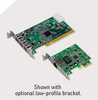
from Matrox Imaging
Matrox Concord is a family of Gigabit Ethernet network interface cards (NICs) and IEEE 1394b adaptors that are pre-licensed for use with the Matrox Imaging Library (MIL) drivers for the GigE Vision ™ and IEEE 1394 IIDC protocols. [See More]
- Port Type: Fire wire (IEEE-1394)
- Host Bus: PCIe
- Protocol / Network: Gigabit Ethernet
- Number of Ports: 3