
Campus Area Network (CAN) Network Modems
Description
Campus Area Network (CAN) Network Modems are devices designed to facilitate communication between various nodes within a network. They serve as a bridge for data transmission, enabling efficient and reliable communication over a network using the CAN protocol. These modems are integral in connecting sensors, actuators, and controllers, allowing them to exchange information seamlessly.
Working Principle
CAN Network Modems operate on the CAN protocol, which is a fast serial bus designed for robust communication. The protocol uses a twisted pair cable to transmit data at speeds up to 1 Mbps, supporting up to 40 devices on a single network. The CAN bus employs a multimaster structure, where each device can send or receive data, but only one device can transmit at any given time. If multiple devices attempt to send data simultaneously, the protocol ensures that the message with the highest priority is sent first. This system is known for its excellent error detection and correction capabilities, making it highly reliable in harsh environments.
Applications
CAN Network Modems are widely used in various fields beyond their original automotive applications. They are employed in industrial automation, where they facilitate communication between machinery and control systems. In medical applications, CAN modems are used to connect different medical devices for synchronized operation. Additionally, they are utilized in building automation systems to manage and control various subsystems like lighting and HVAC.
Advantages over other Network Modems
One of the primary advantages of CAN Network Modems is their ability to reduce wiring complexity and costs. The CAN protocol's two-wire system significantly decreases the amount of cabling required compared to traditional point-to-point communication systems. This reduction in wiring not only lowers material costs but also simplifies installation and maintenance. Furthermore, the CAN protocol's robust error detection and correction features ensure reliable communication even in electrically noisy environments, which is a significant advantage over other network modems that may not perform as well under such conditions.
Limitations
Despite their advantages, CAN Network Modems have limitations. The data transmission speed is capped at 1 Mbps, which may not be sufficient for applications requiring higher bandwidth. Additionally, all nodes on a CAN network must operate at the same frequency, which can be a constraint in systems where different devices require different data rates. The protocol's reliance on a shared bus topology also means that the failure of a single node can potentially disrupt communication across the network.
Considerations
When considering the implementation of CAN Network Modems, several factors should be taken into account. Initial costs can be relatively low due to the reduced wiring requirements, but operating expenses may vary depending on the network's complexity and the environment in which it operates. The durability of CAN modems is generally high, given their design for harsh conditions, but regular maintenance is necessary to ensure continued reliability. Replacement and maintenance costs should be factored into the overall budget, as the failure of a single node can impact the entire network. Additionally, the accuracy of data transmission is typically high, thanks to the protocol's error detection capabilities, but this can be affected by the network's physical layout and the quality of the components used.

from ifm efector inc.
mobile IoT gateway with 4G / LTE mobile network connection. Global transmission of machine and position data to the cloud. Safe TLS end-to-end communication. Buffering of data even with unstable radio connections. Connection to the machine control system via CAN interface. From May 1st 2025,... [See More]
- Area Network Type: CAN
- Modem Type: Radio Modem
- Protocol / Network: CAN; Mobile networks

from ifm efector inc.
mobile IoT gateway with 4G / LTE mobile network connection. Global transmission of machine and position data to the cloud. Safe TLS end-to-end communication. Buffering of data even with unstable radio connections. Connection to the machine control system via CAN interface. From May 1st 2025,... [See More]
- Area Network Type: CAN
- Modem Type: Radio Modem
- Protocol / Network: CAN; WLAN; Bluetooth; Mobile networks

from Softing Industrial Automation GmbH
CANpro USB equips a PC or notebook with a top performing CAN interface with very short response times. It is suitable for a wide variety of CAN and CANopen applications like control, measurement, configuration, and analysis tasks and is also available as a heavy duty version. High Data Throughput... [See More]
- Area Network Type: CAN
- Ports / Interfaces: USB
- Protocol / Network: CAN V2.0 (11/29 Bit-IDs)
- Number of Ports: 1
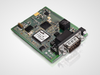
from Softing Industrial Automation GmbH
The compact CANpro USB embedded without housing provides an easy-to-integrate solution of a powerful CAN interface for Industrial PCs. The interface uses the USB 2.0 Highspeed standard and provides very short response times, facilitating a wide variety of CAN and CANopen applications. CAN Interface... [See More]
- Area Network Type: CAN
- Protocol / Network: CAN V2.0 (11/29 Bit-IDs)
- Form Factor: Board
- Ports / Interfaces: USB