
Metal Face Seal Pressure Relief Valves
Description
Metal Face Seal Pressure Relief Valves are designed to protect systems from over-pressurization by allowing excess pressure to be safely vented. These valves maintain system integrity by ensuring that pressure does not exceed a predetermined limit, thereby preventing potential damage to equipment and ensuring operational safety.
Working Principle
Metal Face Seal Pressure Relief Valves operate by utilizing a spring-loaded mechanism. The valve remains closed under normal operating conditions due to the force exerted by a spring. When the pressure in the system exceeds the set threshold, the force of the fluid pressure overcomes the spring force, causing the valve to open. This allows the excess pressure to be released until the system pressure returns to a safe level. The metal face seal ensures a tight seal, minimizing leakage and enhancing the valve's reliability and efficiency.
Applications
These valves are commonly used in high-pressure applications where a reliable seal is critical. Specific examples include aerospace systems, where maintaining precise pressure levels is crucial for safety and performance, and in chemical processing plants, where they help manage the pressure of hazardous fluids to prevent leaks and ensure safe operation.
Advantages over other Process - Valves
Metal Face Seal Pressure Relief Valves offer superior sealing capabilities compared to other types of valves, such as those with elastomeric seals, which may degrade over time or under extreme conditions. The metal-to-metal seal provides enhanced durability and reliability, particularly in high-temperature and high-pressure environments. This makes them ideal for applications where leakage cannot be tolerated.
Limitations
One limitation of Metal Face Seal Pressure Relief Valves is their susceptibility to galling and sticking if not properly maintained or if used in applications where lubrication is not feasible. Additionally, the metal-to-metal contact can lead to wear over time, potentially affecting the valve's performance and lifespan.
Considerations
When selecting Metal Face Seal Pressure Relief Valves, it is important to consider the initial cost, which may be higher than valves with non-metal seals due to the precision manufacturing required. Operating expenses can be minimized through proper maintenance, but the durability and reliability of these valves often justify the investment. Accuracy in maintaining pressure levels is a key advantage, but regular inspection and maintenance are necessary to ensure optimal performance and to prevent costly replacements.

from Plast-O-Matic Valves, Inc.
Features: Economical, multi-purpose valve functions as relief valve, bypass valve, backpressure regulator, pump backpressure valve, anti-siphon valve. Corrosion-resistant design features no wetted metals or elastomers. Responsive, high flow design. Non-rising adjusting bolt. Design & Materials:... [See More]
- Connection Description: Face Seal; BSP or Spigot Connections
- Primary Material: PVC (optional feature); CPVC (optional feature); PTFE (optional feature); PP (optional feature); PVDF (optional feature)
- Maximum Pressure: 5.00 to 50.00
from Air Logic
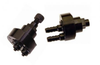
The Valve is designed for precise control in pneumatic control circuits. It can be used as a relay valve to sequence specific signal operations or as a relief valve to limit pressure in a pneumatic system. Fixed or adjustable pressure settings are available; the pressure range is 0-20 PSI. To adjust... [See More]
- Connection Description: Face Seal; Straight ports for 1/16" I.D. Tubing, Barbs for 1/16" or 1/8" I.D. Tubing
- Maximum Pressure: 30.00
- Valve Size: 0.06 to 0.12
- Controlled Pressure Range: 0.00 to 20.00