
Externally Heated Regeneration Compressed Air Dryers
Last Updated: April 1, 2025
Description
Externally Heated Regeneration Compressed Air Dryers are designed to remove moisture from compressed air systems. They achieve this by using an external heat source to regenerate the desiccant material that absorbs moisture from the air, ensuring a continuous supply of dry air.
Working Principle
Externally heated regeneration compressed air dryers operate by using an external heat source to regenerate the desiccant material. The process involves passing the compressed air through a desiccant bed where moisture is absorbed. The desiccant is then regenerated by heating it with an external heater, which allows the moisture to be released and purged from the system. This method is efficient as it reduces the amount of purge air required to less than 7%, enhancing the overall efficiency of the system .
Applications
Externally heated regeneration compressed air dryers are used in various industrial applications where the supply of dry air is critical. Specific examples include:
- Nuclear Power Plants: These dryers are used to ensure the reliability of compressed instrument air systems, which are crucial for the operation of control systems in nuclear facilities .
- General Industrial Use: They are suitable for industries requiring large capacities of dry air, with standard series designed for capacities ranging from 100 to 25,000 SCFM .
Advantages over other Compressed Air Dryers
Externally heated regeneration compressed air dryers offer several advantages over other types of dryers:
- Efficiency: They use a low-watt density Incoloy sheath heater, which increases efficiency and reduces the required purge air to 7% or less .
- Capacity: These dryers are capable of handling large volumes of air, with capacities up to 25,000 SCFM, making them suitable for large-scale industrial applications .
Limitations
One limitation of externally heated regeneration compressed air dryers is their dependency on an external heat source, which can increase the complexity and cost of the system. Additionally, any interruption in the supply of dry purge air can lead to condensation on internal surfaces, potentially affecting performance .
Considerations
When considering externally heated regeneration compressed air dryers, several factors should be taken into account:
- Initial Costs: The initial cost is comparable to other heated dryer designs, but the complexity of the system may influence the overall investment .
- Operating Expenses: Operating costs are influenced by the heater load and the efficiency of the purge air system. The design aims to minimize pressure loss and purge loss, contributing to lower operating expenses .
- Durability and Maintenance: These systems require regular maintenance to ensure the longevity of the desiccant material and the efficiency of the heater. Maintenance can be challenging depending on the design of the desiccant bed .
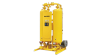
from Kaeser Compressors, Inc.
Kaeser externally heat-regenerative blower purge desiccant dryers produce dew points as low as -40 °F. Twin desiccant beds of activated alumina alternate between drying and regenerating, with regeneration being accomplished with heated ambient air at just above atmospheric pressure. The heated... [See More]
- Regeneration: Externally Heated Regeneration
- Capacity: 500 to 4300
- Dryer Technology: Desiccant
- Min. Dewpoint: -40
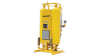
from Kaeser Compressors, Inc.
Model: KED Series. Flow rate: 300 to 3200 scfm. Pressure dew point down to: -4 °F. Solid state logic accurately controls inlet and purge valves which direct wet compressed air to the regenerated tower, and heated purge air to the tower in need of regeneration. The process of adsorption and... [See More]
- Regeneration: Externally Heated Regeneration
- Capacity: 300 to 3200
- Dryer Technology: Desiccant
- Min. Dewpoint: -4

from Ingersoll Rand Industrial Technologies / Air Motors
Ingersoll Rand HB heated blower desiccant dryers are equipped with dedicated durable centrifugal blowers to provide purge air for regeneration, eliminating the need to divert dry compressed air from the air system. Instead, the blower directs ambient air through an external heater and then through... [See More]
- Regeneration: Externally Heated Regeneration
- Capacity: 150 to 8000
- Dryer Technology: Desiccant
- Max. Pressure: 150

from The Kahn Companies
No process air or gas is wasted during regeneration [See More]
- Regeneration: Externally Heated Regeneration
- Capacity: 275
- Dryer Technology: Desiccant
- Max. Pressure: 150
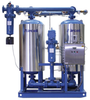
from Aircel
The Aircel AEHD (150 - 3,000 scfm) Externally Heated Desiccant Compresssed Air Dryer is a fully automatic, PLC controlled, selfcontained unit offering a fail-safe design - in the event of power interruption and/or air loss, the purge exhaust valves close preventing damage to the dryer and the... [See More]
- Regeneration: Externally Heated Regeneration
- Capacity: 150 to 3000
- Dryer Technology: Desiccant
- Max. Pressure: 150

from Quincy Compressor
These dryers combine heat with forced ambient air for regeneration. Initial cost: High - Operating cost: Moderately Low - Maintenance cost: Moderately Low. Read more:... [See More]
- Regeneration: Externally Heated Regeneration
- Capacity: 300 to 3400
- Dryer Technology: Desiccant
- Min. Dewpoint: -40 to 10
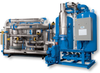
from Aircel
The Aircel HRE & HRS-L (625 - 10,000 scfm) heated blower purge adsorption dryers are designed to provide high drying efficiency by utilizing an external source of heat for regeneration. HRE/HRS-L adsorption dryers significantly reduce or eliminate the use of compressed purge air for regeneration... [See More]
- Regeneration: Externally Heated Regeneration
- Capacity: 600 to 10000
- Dryer Technology: Desiccant
- Max. Pressure: 150