
Sieving / Filtration Particle Analyzers
Last Updated: April 1, 2025
Description
Sieving/Filtration Particle Analyzers are devices used to separate particles based on size. They work by passing a mixture of particles through a series of sieves or filters with varying mesh sizes, effectively sorting the particles into different size categories.
Working Principle
Sieving particle analyzers operate by allowing particles to pass through a series of sieves with progressively smaller openings. As the mixture is agitated, smaller particles fall through the mesh while larger particles are retained. This method is particularly useful for analyzing large particles and is relatively inexpensive. Filtration, on the other hand, involves passing a liquid or gas containing particles through a filter medium that captures particles above a certain size. These techniques are useful for separating solid particles from liquids or gases, and they are essential for ensuring the purity and quality of materials in various industries.
Applications
Sieving and filtration particle analyzers are commonly used in industries such as mining and food processing. In mining, they help in sorting minerals and ores based on particle size, which is crucial for further processing and extraction. In the food industry, they are used to ensure the consistency and quality of products by separating unwanted large particles from ingredients.
Advantages over other Particle Analyzers
Sieving particle analyzers are advantageous due to their cost-effectiveness and simplicity, making them suitable for applications involving large particles. They are also capable of separating particles into size bands, which can be beneficial in processes that require precise particle size distribution.
Limitations
One limitation of sieving particle analyzers is their unsuitability for very fine particles, as the mesh size of sieves limits the smallest particle size that can be analyzed. Additionally, sieving is not effective for emulsions or very dense materials that settle too quickly, as these conditions can lead to inaccurate results.
Considerations
When selecting a sieving or filtration particle analyzer, considerations should include the initial cost of the equipment, which is generally lower compared to more advanced particle analysis methods. Operating expenses are also relatively low, but the durability and maintenance of the sieves or filters can affect long-term costs. Accuracy may vary depending on the particle size range and the specific application, so it is important to choose equipment that matches the requirements of the intended use. Regular replacement and maintenance of sieves or filters are necessary to ensure consistent performance and accuracy.

from Micromeritics
The Micromeritics ElectroPrep is a highly effective system for the preparation of contaminant- free electrolyte for use with the Elzone II and other instruments. If you are looking for an easy-to-use electrolyte filtering device to ensure high-quality particle size data, then Micromeritics ’... [See More]
- Technology: Sieving
- Sample Type: Emulsion
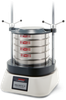
from Fritsch GmbH - Milling and Sizing
Particularly suitable for particle size analysis and portioning of coarse-grained materials. Areas of application. The ANALYSETTE 18 is used for particle size analysis and portioning of coarse-grained materials. The maximum input quantity of 15 kg for the material to be sieved and the sieve stack... [See More]
- Technology: Sieving
- Sample Type: Powder / Solid; Emulsion
- Measurement Type: Size
- Measuring Range: 20 to 125000

from Fritsch GmbH - Milling and Sizing
For quantitative particle size analysis of solids and suspensions of all kinds through dry or wet sieving with woven test sieves or micro-precision sieves. Our top model with automatic amplitude control, programme selection, the ability to be used as a calibratable and validatable test instrument in... [See More]
- Technology: Sieving
- Sample Type: Powder / Solid; Emulsion
- Measurement Type: Size
- Measuring Range: 20 to 63000