
Pulse & Direction Linear Encoders
Last Updated: April 1, 2025
Description
Pulse & Direction Linear Encoders are devices that translate linear motion into electrical signals. These signals can be interpreted by a control device to determine the position of an object along a linear path. The encoder generates a series of pulses that correspond to the movement, allowing for precise tracking of position changes.
Working Principle
Pulse & Direction Linear Encoders operate by generating a fixed number of pulses as an object moves along a linear path. The number of pulses corresponds to the distance traveled, while the direction of movement is determined by monitoring which channel of pulses leads the other. This method allows for accurate tracking of both position and direction. The encoders are useful because they provide precise position information, which is critical for applications requiring high accuracy and repeatability.
Applications
Pulse & Direction Linear Encoders are commonly used in applications where precise linear positioning is required. Specific examples include CNC machines, where they help in accurately positioning the cutting tool, and in robotics, where they ensure precise movement of robotic arms. They are also used in automated assembly lines to track the position of components as they move through the production process.
Advantages over other Linear Encoders
One advantage of Pulse & Direction Linear Encoders is their ability to provide high-resolution position information through interpolation of the quadrature output, achieving values as high as 131,072 pulses per revolution. This high resolution allows for more precise control compared to other types of encoders that may not offer such detailed position feedback.
Limitations
A significant limitation of Pulse & Direction Linear Encoders is that they lose all positional information if power is lost. This requires a reset or homing cycle to synchronize the encoder with the control device once power is restored. Additionally, their accuracy can be affected by temperature changes due to the temperature-sensitive coefficient of expansion of the materials used in their construction.
Considerations
When considering Pulse & Direction Linear Encoders, it is important to evaluate initial costs, which can vary depending on the resolution and type of encoder. Operating expenses may include maintenance and potential replacement costs due to wear and tear, especially in contact-type encoders. Non-contact types generally offer longer durability. Accuracy is a critical factor, and users should ensure that the encoder's resolution meets the application's requirements. Replacement and maintenance costs should also be considered, as these can impact the overall cost of ownership over the encoder's lifespan.
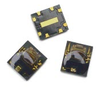
from Broadcom Inc.
The AEDR-850x encoder is the smallest 3 channel optical encoder in the world with digital outputs employing reflective technology for motion control purposes. The encoder is designed to operate over -20 ° C to 85 ° C temperature range and therefore is suitable for both commercial and... [See More]
- Incremental Encoder Signal: Pulse & Direction
- Linear Encoder Technology: Optical
- Operating Temperature: -4 to 185
- Encoder Reading: Incremental

from Magnescale Americas, Inc.
Robust, incremental, linear magnetic scale system for machine tools. [See More]
- Incremental Encoder Signal: Pulse & Direction
- Resolution: 1.00E-5 to 5.00E-5
- Measurement Range: 5.51 to 120
- Linear Encoder Speed: 833 to 3333

from Broadcom Inc.
The HEDS-9700 series is a high performance, low cost, optical incremental encoder module. When operated in conjunction with either a codewheel or codestrip, this module detects rotary or linear position. The module consists of a lensed LED source and a detector IC enclosed in a small C-shaped... [See More]
- Incremental Encoder Signal: Pulse & Direction
- Operating Temperature: -40 to 185
- Linear Encoder Speed: 20
- Linear Encoder Technology: Optical

from Magnescale Americas, Inc.
Slim type, incremental, linear magnetic scale system for machine tools. [See More]
- Incremental Encoder Signal: Pulse & Direction; Reference/Index
- Resolution: 1.00E-5 to 5.00E-5
- Measurement Range: 2.76 to 80.32
- Linear Encoder Speed: 833 to 3333