
Single Channel Linear Encoders
Last Updated: April 1, 2025
Description
Single Channel Linear Encoders are devices used to measure straight-line motion. They provide position information by detecting linear displacement, which is essential for precise motion control in various engineering applications.
Working Principle
Single Channel Linear Encoders operate by sensing position from precision graduations, or position codes, etched on a linear scale. These encoders can be either contacting or non-contacting. In non-contacting types, optical sensors detect the graduations on a glass scale, which helps in preserving accuracy by minimizing wear and tear. The encoder system typically includes a light source, light detector, code wheel or scale, and a signal processor. This setup allows for extremely accurate position information, making them useful in applications where precise motion control is critical.
Applications
Single Channel Linear Encoders are commonly used in CNC machines and precision stages, where accurate measurement of linear displacement is crucial. They are also employed in robotics, where precise position feedback is necessary for tasks that require high accuracy and repeatability.
Advantages over other Linear Encoders
One of the primary advantages of Single Channel Linear Encoders, particularly the non-contacting types, is their longer lifespan. This is due to the use of optical components instead of mechanical brushes or wipers, which reduces wear and maintenance needs. Additionally, the optical sensing method provides high accuracy and reliability, which is beneficial in applications requiring precise motion control.
Limitations
A significant limitation of Single Channel Linear Encoders is their sensitivity to temperature changes, which can affect the accuracy of the position information due to the coefficient of expansion of the materials used in the scale. This can be a concern in environments with fluctuating temperatures.
Considerations
When considering Single Channel Linear Encoders, it is important to evaluate the initial costs, which can vary depending on the type and precision required. Operating expenses are generally low due to the minimal maintenance needs of non-contacting types. However, durability can be affected by environmental factors such as temperature and contamination. Accuracy is typically high, but it is crucial to ensure that the encoder is suitable for the specific application requirements. Replacement and maintenance costs are generally lower for non-contacting types, but it is essential to consider the potential need for recalibration or replacement in harsh environments.
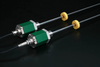
from Exsenco, LLC
SANTEST's GYSE-probe is an all-in-one type sensor with positional resolution up to 1 μm. Posiiton output is Analogue, SSI, or Incremental. Velocity output is optional and is available for Analog type. The positional difference between 2 magnets can be observable as well. This allows quick and... [See More]
- Incremental Encoder Signal: Single Channel
- Linearity: 0.0250
- Measurement Range: 0.5906 to 205
- Resolution: 0.0020 to 0.0100
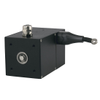
from Encoder Products Company
The Linear Cable Encoder (LCE) provides a low-cost alternative for obtaining accurate linear measurements. As opposed to typical rotary shaft style encoders, the LCE has a retractable stainless steel cable, allowing for numerous measuring configurations. Placing the LCE away from harsh environmental... [See More]
- Incremental Encoder Signal: Single Channel
- Resolution: 0.0508
- Measurement Range: 0.0 to 50
- Signal Quadrature: Signal Quadrature