
Gray Linear Encoders
Last Updated: April 1, 2025
Description
Gray Linear Encoders are devices used to provide precise position information by detecting the position from precision graduations etched on a linear scale. They are designed to convert linear displacement into electronic signals, which can then be processed to determine the exact position of an object along a linear path.
Working Principle
Gray Linear Encoders operate by using precision graduations on a linear scale, which are typically detected by optical sensors. The Gray Code is utilized in these encoders, where successive values differ by only one bit, minimizing errors during state transitions. This coding method is particularly useful in preventing errors that can occur with binary code due to transitory states. The non-contacting nature of optical components in these encoders contributes to their longevity and reliability, as there is no physical wear from contact.
Applications
Gray Linear Encoders are commonly used in environments where precise position feedback is crucial. They are often found in industrial automation systems, CNC machines, and robotics, where accurate linear positioning is essential for the operation of machinery. These encoders are also used in applications that require high precision and reliability, such as semiconductor manufacturing equipment and precision measurement instruments.
Advantages over other Linear Encoders
One of the primary advantages of Gray Linear Encoders over other types is their use of Gray Code, which reduces the likelihood of errors during state transitions. This makes them particularly reliable in applications where precision is critical. Additionally, the non-contacting optical components used in these encoders contribute to a longer lifespan and reduced maintenance compared to contacting types that may suffer from wear and tear.
Limitations
Gray Linear Encoders can be limited by their sensitivity to environmental conditions, such as temperature fluctuations, which can affect the accuracy of the position information due to the coefficient of expansion of the scale material. Additionally, the initial cost of these encoders can be higher compared to simpler encoder types, which may be a consideration for budget-conscious applications.
Considerations
When considering Gray Linear Encoders, it is important to evaluate the initial costs, which can be higher due to the precision and technology involved. Operating expenses may be lower in the long term due to the reduced need for maintenance, thanks to the non-contacting design. Durability is generally high, but environmental factors such as temperature and contamination should be considered to ensure accuracy and longevity. Replacement and maintenance costs are typically lower than those for contacting encoders, as there is less physical wear involved.
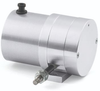
from Lika Electronic
Absolute draw-wire encoder. Robust and compact design. Resolution from 0.1 to 0.012 mm. Measuring range 1000 and 2000 mm [See More]
- Absolute Encoder Code: Gray; Binary
- Resolution: 0.0120 to 0.1000
- Measurement Range: 78.74
- Linear Encoder Speed: 1000

from Hymark/Kentucky Gauge
Absolute draw-wire encoder. Robust and compact design. Resolution from 0.1 to 0.012 mm. Measuring range 1000 and 2000 mm [See More]
- Absolute Encoder Code: Gray; Binary
- Resolution: 0.0120 to 0.1000
- Measurement Range: 39.37 to 78.74
- Linear Encoder Speed: 1000

from Lika Electronic
Self-diagnostics on tape distance & integrity. Measuring length up to 600 mm [See More]
- Absolute Encoder Code: Gray; Binary
- Resolution: 0.1000 to 1.25
- Measurement Range: 23.62
- Linear Encoder Speed: 5000
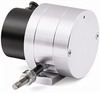
from Hymark/Kentucky Gauge
DESCRIPTION. Draw wire encoder. Robust and space saving construction. Integrated incremental encoder. Measuring length up to 2000 mm. Electromedical [See More]
- Absolute Encoder Code: Gray; Binary
- Resolution: 0.0120 to 0.1000
- Measurement Range: 39.37 to 78.74
- Linear Encoder Speed: 1000