
PLC Controller Assembly and Insertion Presses
Description
Programmable Logic Controllers (PLCs) are specialized computing devices used to automate industrial processes. They are designed to manage various electro-mechanical tasks in sensors, actuators, plants, and other industrial processes. PLCs are adaptable to a wide range of operations, including motion control, positioning control, and torque control. They are frequently customized to fit specific applications, providing a versatile solution for industrial automation needs.
Working Principle
PLCs operate by continuously monitoring and adjusting process variables through direct digital control, distributed control, and programmable control. They are microprocessor-based systems that can be easily programmed and modified, allowing for flexibility in operation. PLCs are capable of handling both analog and digital inputs and outputs, and they can be expanded with plug-in modules to manage a large number of signals and control various devices simultaneously. This makes them particularly useful for decision-making in complex process control systems, where they can perform tasks such as sequential control and alarm functions.
Applications
PLCs are widely used in industrial automation applications. For example, they are integrated into industrial robots, allowing these robots to function independently of a master PLC, which can result in significant cost savings for smaller companies. PLCs are also employed in automation projects to enhance the profitability of manufacturing operations by speeding up setup and simplifying laborious tasks.
Advantages over other Assembly and Insertion Presses
PLCs offer several advantages over other types of assembly and insertion presses. They provide a high degree of flexibility and can be easily reprogrammed to accommodate changes in production processes. This adaptability makes them suitable for a wide range of industrial applications. Additionally, PLCs are known for their reliability and ability to handle complex control tasks, which can lead to increased productivity and efficiency in industrial settings.
Limitations
One limitation of PLCs is that they may not be suitable for very complex or data-intensive control systems, where personal computers or single-board computers might be more appropriate. In such cases, the high development costs associated with PC interfacing may be justified. Additionally, while PLCs are versatile, they may not be the best choice for applications requiring extremely high processing power or advanced computing capabilities.
Considerations
When considering the use of PLCs, it is important to evaluate factors such as initial costs, operating expenses, durability, accuracy, and maintenance requirements. PLCs are generally cost-effective for a wide range of applications, but the specific needs of the operation should be assessed to determine the most suitable control system. Durability and reliability are key advantages of PLCs, but regular maintenance and updates may be necessary to ensure optimal performance. Additionally, the ease of programming and flexibility of PLCs can lead to reduced long-term costs, as they can be easily adapted to changing production requirements.
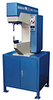
from PennEngineering®
The PEMSERTER ® Series 4 ® press is totally pneumatic providing short cycle time for increased productivity and 53.4 kN / 6 tons of force and a 45.7 cm / 18 ” throat depth which provides clearance for a variety of chassis configurations. It is designed to install self-clinching... [See More]
- Automation / Control: PLC Controller
- Capacity: 0.5058 to 6
- Operation: Insertion or Press Fitting
- Throat: 17.99

from Weber Screwdriving Systems, Inc.
Efficient system for blind riveting. For setting captive inserts, WEBER supplies an automatic setting unit suitable for round and hexagon head, steel or aluminum inserts in sizes between M5 and M12. The controller and the feed system are integrated and form a single unit. Unlike older technologies,... [See More]
- Automation / Control: PLC Controller
- Capacity: 2.25
- Operation: Insertion or Press Fitting
- Technology: Servo