
Products & Services
See also: Categories | Featured Products | Technical Articles | More Information-
Supplier: Quincy Compressor
Description: Based on the proven performance of the QR-25, an air compressor with over 80 years of reliable service, but engineered exclusively for natural gas applications, the Quincy QRNG is constructed of heavy-duty cast iron for strength and durability. The cylinders are cast with horizontal
- Discharge / Operating Pressure: 15 to 400 psi
- Horse Power: 2 to 34 HP
- Features: 2 Stage, Multistage Compressor
- Gases Handled: Natural Gas / Methane
-
Supplier: Universal Air & Gas Products Corp.
Description: Since 1962, Universal Air & Gas Products Corporation (aka Universal Air Precipitator or UAPC) has manufactured a wide range of gas compressors to match virtually every compressor application. Our compressor products range in discharge pressure from vacuum to 6000
- Discharge / Operating Pressure: 35,000 psi
- Flow Capacity: 5 to 2,600 SCFM
- Horse Power: 1 to 500 HP
- Power Source: AC Single Phase, AC Three Phase, Diesel, Gasoline, Hydraulic
-
Supplier: Advanced Gas Technologies
Description: Advanced Gas Technologies Inc. has been marketing, installing and maintaining industrial gas generating systems, standard industrial compressor systems and engineered compressor systems throughout North America since 1994. High Pressure Gas Reciprocating
- Discharge / Operating Pressure: 7,000 psi
- Horse Power: 3 to 1,600 HP
- Features: 2 Stage, 3 Stage, More Than 3 Stages, Multistage Compressor, Other
- Gases Handled: Argon, Carbon Dioxide (CO2), Helium, Hydrocarbon Gas, Natural Gas / Methane, Nitrogen (N2), Oxygen (O2)
-
-
Supplier: GENERON
Description: APPLICATIONS Air Separation Alternate Fuel Chemical Process Plants Gas Gathering Gas Lift Gas Turbine Fuel Boosting Instrument Air Inert Gas Compression Natural Gas Compression For NGL Offshore Seismic Energy Source Pipeline Transmissions Process Gas Rig
- Discharge / Operating Pressure: 10,000 psi
- Flow Capacity: 24,290 SCFM
- Horse Power: 2 to 10,000 HP
- Power Source: AC Single Phase, AC Three Phase, DC, Diesel, Gasoline
-
Supplier: GENERON
Description: FEATURING Pressures up to 600 psig (41 barg) Safe or Hazardous Locations Air or Water cooled Flow rates up to 5000 cfm (8500m3/hr) Standard or engineered packages TYPICAL APPLICATIONS Air Separation Biogas Coal Seam Gas Gathering Instrument Air Landfill Process Gas Vapor Recovery (VRU)
- Discharge / Operating Pressure: 600 psi
- Flow Capacity: 5,000 SCFM
- Horse Power: 2 to 5,000 HP
- Power Source: AC Single Phase, AC Three Phase, DC, Diesel, Gasoline
-
Supplier: GENERON
Description: Lubricated Air & Gas Compressor Packages up to 10,000 psig Custom Engineered Compression Solutions Custom Controls and Automation Air or Liquid Cooling Systems Factory Testing and On-Site Start-Up Training Onshore and Offshore Applications Thousands of systems installed and
- Maximum Temperature: 0 to 2,000 SCFM
- Maximum Pressure: 10,000 psi
- Type: Gas Dryer, In-line
- Application / Industry: Hydrocarbon Processing (Oil & Gas), Municipal Water Supply
-
Supplier: GENERON
Description: GENERON offers 2hp to 5,000hp, (1.5kw to 3,730kw). Industry proven engineered OIL-FREE Reciprocating Compression Packages, built to any technical specification using diesel or electric motor drives. Our packages move large volumes of air or gas, from ambient or elevated suction pressures, to
- Discharge / Operating Pressure: 10,000 psi
- Flow Capacity: 3,000 SCFM
- Horse Power: 2 to 5,000 HP
- Power Source: AC Single Phase, AC Three Phase, DC, Diesel, Gasoline
-
Supplier: Rolair Systems
Description: PUMP DESCRIPTION : Heavy-Duty, Two Stage, Cast-Iron Twin Cylinders, Ball Bearings, Splash Lubricated, Cast Iron Valve Plates with Swedish Lamellar Reed Valves, Aluminum Alloy Connecting Rods with Automotive-Style Inserts, Multi-Finned 15.16" Flywheel, Oil Sight Gauge ENGINE DESCRIPTION : 8 HP,
- Flow Capacity: 20.1 SCFM
- Horse Power: 8 to 9 HP
- Features: 2 Stage, Integral Filter, Multistage Compressor
- Power Source: Gasoline
-
Supplier: Ingersoll Rand Air Compressors
Description: For over thirty years, Ingersoll Rand has been the leader in Compressed Natural Gas (CNG) for the Natural Gas Vehicle (NGV) market, providing a wide range of safe, reliable and easy-to-service modular compression packages. Designed for heavy use, Ingersoll Rand CNG compressors
-
Supplier: FS-Curtis
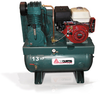
Description: You shouldn’t have to sacrifice quality and durability with your air compressor purchase. That’s why FS-Curtis created the CT Series. These reciprocating compressors combine our signature performance and reliability with a simple industrial design, making them the most rugged — and
- Discharge / Operating Pressure: 24.8 to 25.4 psi
- Horse Power: 13 to 14 HP
- Compressor Technology: Reciprocating Piston
-
Supplier: FS-Curtis
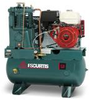
Description: stainless-steel valve system delivers more cfm per horsepower Robust intercooler increases compressor efficiency Metal intake filter/silencer is superior to plastic Heavy-duty stamped-steel belt guard Suction valve head unloaders for continuous running air compressors Gas-driven
- Discharge / Operating Pressure: 22 to 22.5 psi
- Compressor Technology: Reciprocating Piston
-
Supplier: Advanced Gas Technologies
Description: Advanced Gas Technologies Inc. has been marketing, installing and maintaining industrial gas generating systems, standard industrial compressor systems and engineered compressor systems throughout North America since 1994. CNG Compressor Packages Industrial duty 2,
- Discharge / Operating Pressure: 5,000 psi
- Horse Power: 5 to 500 HP
- Features: 2 Stage, 3 Stage, Integral Cooler, More Than 3 Stages, Multistage Compressor
- Applications: Gas Generation / PSA
-
Supplier: Advanced Gas Technologies
Description: Advanced Gas Technologies Inc. has been marketing, installing and maintaining industrial gas generating systems, standard industrial compressor systems and engineered compressor systems throughout North America since 1994. Diaphragm Compressors Features From 3 HP
- Discharge / Operating Pressure: 30,000 psi
- Horse Power: 3 to 125 HP
- Gases Handled: Argon, Carbon Dioxide (CO2), Corrosive / Sour Gas, Helium, Hydrocarbon Gas, Natural Gas / Methane, Nitrogen (N2), Oxygen (O2)
- Compressor Technology: Diaphragm
-
Supplier: Howden
Description: Burton Corblin® D-Series of Diaphragm Compressors Leak tight, high pressure process compressor packages for situations where complete isolation of gas is vital, including oil and gas processes, production sites and laboratories handling high purity, rare, toxic,
- Discharge / Operating Pressure: 43,511.31 psi
- Horse Power: 13.4022038490282 to 1,742.28650037367 HP
- Gases Handled: Corrosive / Sour Gas, Helium, Hydrocarbon Gas, Natural Gas / Methane, Nitrogen (N2)
- Compressor Technology: Diaphragm
-
Supplier: Howden
Description: Burton Corblin Periflow® Range of Peripheral Compressors The Periflow® compressor has its own performance characteristics situated between those of volumetric displacement blowers and centrifugal compressors. Periflow® compressors provide a cost-effective option when
- Discharge / Operating Pressure: 2,900.754 psi
- Horse Power: 1,340.22038490282 HP
- Gases Handled: Ammonia, Carbon Dioxide (CO2), Corrosive / Sour Gas, Hydrocarbon Gas, Natural Gas / Methane, Nitrogen (N2)
- Compressor Technology: Centrifugal
-
Description: At Johnson Controls, we engineer reliable gas compressors for custom packagers and system integrators to use in their critical processing applications. The Frick® SGC, SGCH & SGCB bare screw compressors are designed to compress a variety of gases for quality solutions in
- Flow Capacity: 71 to 5,067 SCFM
- Applications: Oil / Vapor Recovery, Refrigeration / Gas Drying
- Features: Other
-
Supplier: Advanced Gas Technologies
Description: Advanced Gas Technologies Inc. has been marketing, installing and maintaining industrial gas generating systems, standard industrial compressor systems and engineered compressor systems throughout North America since 1994. Reciprocating Compressors Features
- Discharge / Operating Pressure: 250 psi
- Flow Capacity: 102 SCFM
- Horse Power: 3 to 25 HP
- Features: 2 Stage, Multistage Compressor
-
Supplier: Chemac Inc./Uraca/Uhde HPT/Gather/BHDT
Description: For over 80 years our HOFER Compressor Technologies have supplied piston compressors, diaphragm compressors, hydraulically driven non-lubricated compressors. Upon request, they can be completely equipped with valve- and instrument panels. HOFER Compressor
-
Supplier: Thermocold Costruzioni Srl
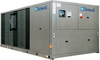
Description: Air/water chillers with Free Cooling with propeller fans and hermetic scroll compressors. ENERGY SAVING MAXIMIZATION: FREE COOLING allows the exploiting of low external air temperature in order to cool the water return from the system free of charge. • Scroll compressors.
-
Supplier: Thermocold Costruzioni Srl
Description: Refrigerant R134a. Casing made with heavy gauge structure in painted steel on specific. Semi-hermetic screw compressors with regulation drawer Liquid receivers. Separate cooling circuits with full accessories (gas filter / indicator / etc.) flange connection. Control panel with
- Cooling Capacity: 150 to 570 kW
- Application: HVAC, Industrial
- Condenser Cooling: Water-Cooled
-
Supplier: Thermocold Costruzioni Srl
Description: Power: 8Kw ÷ 10Kw R134a refrigerant.Casing entirely made of Peralluman. Panels with soundproof insulation. Scroll compressor. Liquid receiver. Separate cooling circuits with full accessories (gas filter /indicator / etc.) and flange connection. Control panel with a junction box
- Cooling Capacity: 8 to 10 kW
- Application: HVAC, Industrial
- Condenser Cooling: Water-Cooled
-
Supplier: Champion
Description: Reciprocating Air-Cooled Air Compressors Value Plus The Value Plus Line of Air Compressors was engineered for industrial applications that require a gas or electric driven compressor. Each compressor was designed with top quality bearings, cast iron cylinders, and
- Discharge / Operating Pressure: 175 psi
- Flow Capacity: 10.2 to 44.4 SCFM
- Horse Power: 3 to 15 HP
- Features: 2 Stage, Multistage Compressor
-
Supplier: Thermocold Costruzioni Srl
Description: Power: 35Kw ÷ 40Kw Refrigerant R134a. Casing made with AISI 316L. Panels insulated with soundproofing. Semihermetic compressors with partialization heads. Liquid receivers. Separate cooling circuits with full accessories (gas filter /indicator / etc.) flange connection. Control
- Cooling Capacity: 35 to 40 kW
- Application: HVAC, Industrial
- Condenser Cooling: Water-Cooled
-
Supplier: FLSmidth
Description: Developed from Fuller® design and technology, FLSmidth’s Ful-Vane™ Compressors provide more compression with less energy. Available in flow ranges from 50 SCFM to 3000 SCFM and in single- or two-stages with suction pressure ranges down to -29.8″ Hg, Ful-Vane compressors are well suited
-
Description: Compressors C-DLR Volume flow 60 to 600 m³/hr 35.3 to 352.9 cfm High efficiency, dry and contact-free compression claw compressor with capacities ranging from 60 to 600 m³/hr (35.3 to 352.9 cfm). Pressure up to max. 2.2 bar at continuous operation. Low maintenance, integrated air
- Discharge / Operating Pressure: 31.908294 psi
- Flow Capacity: 35.3 to 352.9 SCFM
- Features: Other
-
Supplier: BITZER US, Inc.
Description: The compact semi-hermetic reciprocating compressors are suitable for a whole host of refrigerants. Our compressors boast an efficient suction gas–cooled motor, high-quality valve plates, wear-resistant drive gears and adjustable capacity control.
- Features: Other
- Construction: Piston
-
Description: operation. High efficiency and silent operation. Sound cover allows a ducted cooling air outlet either from one side only or from both sides. Easy servicing and operation. Compressors V-DTE Dry running Volume flow 3.5 to 12 m³/hr 2.1 to 7.1 cfm Small, dry running rotary vane
- Flow Capacity: 2.1 to 51.7 SCFM
- Lubrication Style: Oil-free
- Features: Other
-
Supplier: Universal Air & Gas Products Corp.
Description: Since 1962, Universal Air & Gas Products Corporation (aka Universal Air Precipitator or UAPC) has manufactured a wide range of air compressors to match virtually every compressor application. Our compressor products range in discharge pressure from vacuum to 6000 psig and
- Discharge / Operating Pressure: 35,000 psi
- Flow Capacity: 5 to 2,600 SCFM
- Horse Power: 1 to 500 HP
- Power Source: AC Single Phase, AC Three Phase, Diesel, Gasoline, Hydraulic
-
Supplier: Senior Aerospace Metal Bellows
Description: instrument gas sampling Nuclear containment radiation monitoring Radioactive gas processing Ground based or airborne high voltage electronics cooling and waveguide pressurization High temperature engine exhaust analysis Toxic or costly gas processing Contamination free
- Discharge / Operating Pressure: 40 psi
- Flow Capacity: 5 SCFM
- Horse Power: 0.75 HP
- Power Source: AC Single Phase
-
Supplier: Busch Vacuum Solutions
Description: without filtration or cleaning. In addition, no costs arise for the purchase, replacement and disposal of operating fluids. Mink claw vacuum compressors are air cooled, so no effort for the installation and maintenance of a cooling system is required. Their contact-free operating
- Inlet Temperature: 104 F
- Discharge / Operating Pressure: 23.21 psi
- Flow Capacity: 341.4 SCFM
- Horse Power: 40 HP
-
Supplier: Aerzen USA Corp.
Description: used for both stationary and mobile air compressors and for temperatures between -10 and +45 °C. And with 10 power levels, they are sure to become your first choice when it comes to configuring high-quality air compressors. Premium quality with many advantages. High level of
- Discharge / Operating Pressure: -7.25 to 188.55 psi
- Flow Capacity: 41.202 to 1,871.748 SCFM
- Gases Handled: Air / Plant Air, Natural Gas / Methane
- Lubrication Style: Lubricated
-
Supplier: Kaeser Compressors, Inc.
Description: for a wide variety of applications including: Gas for metal welding and laser cutting Detecting gas for leak tests Cooling fluid for machines, reactors and generators Heat treating metallic parts Medical nuclear magnetic resonance and tomography Research and development for
- Discharge / Operating Pressure: 72 to 217 psi
- Flow Capacity: 10 to 3,002 SCFM
- Horse Power: 3 to 700 HP
- Gases Handled: Air / Plant Air, Helium, Nitrogen (N2)
-
Supplier: Senior Aerospace Metal Bellows
Description: instrument gas sampling Nuclear containment radiation monitoring Radioactive gas processing Ground based or airborne high voltage electronics cooling and waveguide pressurization High temperature engine exhaust analysis Toxic or costly gas processing Contamination free
- Discharge / Operating Pressure: 40 psi
- Flow Capacity: 5 SCFM
- Horse Power: 0.75 HP
- Power Source: AC Single Phase
-
Supplier: BITZER US, Inc.
Description: With the built-in preprogrammed frequency inverter of the VARISPEED series, the speed can be infinitely adjusted, which increases efficiency and lowers energy costs. The built-in suction gas cooling of the frequency inverter increases operating reliability and reduces maintenance to
- Features: Other
- Construction: Piston
-
Supplier: FS-Curtis
Description: high efficiency and are an extension of our current offering of Oil Less piston compressors. FS-Curtis oil free compressors serve the majority of your compressed air needs. Oil-Less Design System contains no oil, unlike dry screw compressors. Water cools, seals and lubricates
- Discharge / Operating Pressure: 115 to 120 psi
- Horse Power: 20 to 150 HP
- Compressor Technology: Rotary Screw















Find Suppliers by Category Top
Featured Products Top
-
 Cement and Lime Industry Blowers and Compressors designed for better Solutions in Cement Applications Depending on your cement plant’s operations, the specialists at AERZEN can tailor make a (read more)
Browse Air Compressors Datasheets for Aerzen USA Corp. -
). USA: President Biden recently announced a new target to achieve 50-52% reductions from 2005 levels in economy-wide net greenhouse gas pollution in 2030. This puts pressure on design engineers to increase efficiency of their compressors by reducing weight and size, as (read more)
Browse Industrial Coatings Datasheets for GGB -
heat burns off certain materials as gases. The elements left behind then meld together, forming a material known as clinker. The clinker exits the kiln, cools, and is ground into an extremely fine powder that you can load onto trucks and transport to concrete suppliers. The wet method (read more)
Browse Air Compressors Datasheets for Aerzen USA Corp. -
Control system design and process or plant engineers in search of a fuel gas measurement solution for natural gas compressor skids will find that the economical, low-maintenance Wafer-Cone® Flow Meter (read more)
Browse Flow Meters Datasheets for McCrometer, Inc. -
Vacuum Blower with Pre-inlet Cooling AERZEN blowers with canned drive are designed for the conveyance of neutral and aggressive gases and are especially used in the industrial (read more)
Browse Fans and Blowers (industrial) Datasheets for Aerzen USA Corp. -
providing a long service life. In-line check valves can be used in the following applications: Compressor discharge Pumps Boilers Water treatment Generators Cooling towers (read more)
Browse Check Valves Datasheets for DFT Inc. -
cleaning systems, cooling systems, filtration equipment, and wastewater systems. This means that the longer the motors and pumps run, electricity consumption and costs increase. When heating water for cleaning and sanitation purposes, large amounts of natural gas and electricity (read more)
Browse Manifolds and Manifold Systems Datasheets for Paxton Products, an ITW company -
: Centrifugal pumps Ventilation fans Cooling-tower fans Air-handling units (read more)
Browse Electric Rotary Actuators Datasheets for ERSAELECTRONICS PTE. LTD. -
blowers feature gas-tight, permanent magnet motors with active magnetic bearings, integrated frequency converters and closed-loop water cooling. Units are compact and quiet plus advanced controls offer full interoperability with SCADA systems. (read more)
Browse Fans and Blowers (industrial) Datasheets for Kaeser Compressors, Inc. -
chemical processing, water treatment, food and beverage, pharmaceuticals, oil and gas, and automotive manufacturing. Our bag filter housings are engineered for: High-efficiency filtration – compatible with standard filter bags (size 1 & 2) to meet diverse micron ratings (read more)
Browse Filter Housings Datasheets for Harbory Filtration
Conduct Research Top
-
Gas Leak Detector-Application Note: COMPRESSOR STATIONS
At a compressor or booster station, two main. processes typically take place: gas compression,. which is performed in order to ensure that the. natural gas flowing through a pipeline remains. pressurized, and gas chilling and cooling, which. reduces the gas temperature. Both processes. subject gas
-
Water Cooled Test Chamber Information
Why do CSZ's larger test chambers need cooling water? The water is used to cool the large capacity refrigeration systems at its condenser (where the refrigerant changes phase from a gas to a "condensed" liquid). Our smaller chambers have air-cooled condensers that expel the heat directly
-
Improved Reliability and Lower Total Cost of Ownership with Magnetic Bearings
With over 20 years of experience Lukoil, a leading oil & gas business of Russia, aspired to expand oil & gas fields in Russia. For the expansion, Lukoil decided on the Bolshekhetskaya depression in West Siberia where large deposits of Cenomanian gas lay. Developing and constructing a compressor
-
How Specifications Can Ruin a Good Project
Since August 2014, 315 Machine Design has been providing engineering and project management services for a client on a liquid natural gas (LNG) export facility project. The LNG project's general engineering and construction contractor hired our client to design and build a cooling system to remove
-
Pressure Sensor Application - Pressure Verification
Pressure sensors are used to measure pressure in fluid or gas applications. In this particular example, gas is compressed in the compressor. When the gas is let out it needs to be cooled down since compression of gas usually increases its temperature. The pressure sensor monitors the actual
-
PROTECT YOUR INVESTMENT: Five factors to consider before making the switch to aftermarket oil
images. illustrate the impact on seal. faces tested using OEM oil and. aftermarket oil. The OEM oil test. (on top) showed virtually no wear. after 400 hours. The aftermarket. oil (on bottom), which included. untested additives, resulted in. compressor failure. FIELD TEST: Natural Gas Plant with OEM Oil
More Information Top
 Indicates content that may require registration and/or purchase.

-
Combined Cycle Driven Efficiency for Next Generation Nuclear Power Plants
An intercooler is a heat exchanger that cools compressor gas during the compression process.
-
Aluminum Alloy Performance in Industrial Air-Cooled Applications
As a second level of corrosion assessment, Battelle placed lengths of alu- minum finned tubes on and around air- cooled gas compressors at two Gulf Coast industrial sites.
-
http://dspace.mit.edu/bitstream/handle/1721.1/17026/54495585-MIT.pdf?sequence=2
Cooling gas compressor inlet .
-
IUTAM Symposium on Emerging Trends in Rotor Dynamics
Fig. 3 Turbo-blower: cooling gas compressor (CO2) for a power laser, cutting metal sheets up to 25 mm.
-
Magnetic Bearings
Cooling gas compressor for power laser, speed 54000 rpm, motor power 12 kW (photo courtesy TRUMPF/Mecos .
-
Protect the Forest With LNG
The option to use gas turbines for the cooling gas compressors may be replaced by the use of electric motors as a consequence of the plant's modular construction.
-
Technology, safety, and costs of decommissioning reference nuclear research and test reactors. Appendices
Water- Cooled Compressor Gas Storage Tank Condensate Pump .
-
Ironmaking Process Alternative Screening Study, Volume 1
Cooling Gas Compressor .
-
Digesters for Korea | Archive | The Engineer
In a £780,000 order, Utile Engineering, of Irthlingborough, Northamptonshire, will supply digester gas mixing equipment comprising 16 water- cooled gas compressor sets to Daewoo Corporation for installation at South Korea's Gulpocheon sewage treatment plant.
-
20 Years of Experience in VSDs for High Power Compressors of Steam Crackers
- cooling gas compressors with variable speed electric motor .