Products/Services for Manufacturer Thermopile
-
 Thermopiles - (39 companies)Thermopiles are thermocouples arrays, wired in series that are used in motion sensing applications. Thermopiles are thermocouple arrays that are wired in series and used in motion sensing applications. They are relatively simple in design...Electrical Outputs
 -
 Noncontact Infrared Temperature Sensors - (375 companies)Thermocouples or thermopiles. Pyrometers or pyroelectric devices. Optical pyrometers. Electrical output options for noncontact infrared temperature sensors include: Analog current. Analog voltage. Analog frequency. Serial. Parallel. Switch. Alarm. Additional...
 -
 Thermocouple Elements - (330 companies)Thermocouple elements are temperature sensors that are useful over a wide range of temperatures. Thermocouples are formed by two dissimilar metals.
 -
 Focal Plane Arrays - (19 companies)Focal plane arrays (FPA) are detectors consisting of a linear or two-dimensional matrix of individual detector elements, typically used at the focus of an imaging system.
 -
 Residual Gas Analyzers - (103 companies)Residual gas analyzers (RGAs) identify the gases present in vacuum environments.
 -
Thermocouple Temperature Transmitters - (341 companies)Thermocouple temperature transmitters convert the small millivolt output of a thermocouple to a current signal (typically 4-20 mADC) that is immune to noise and voltage drops over a long distance.
-
Dissolved CO2 Instruments - (40 companies)Dissolved CO2 instruments are analytical devices that measure the amount of carbon dioxide (CO2) dissolved in a liquid sample such as water. They typically include a submerged probe that is covered by a thin organic membrane.
-
Alternative Power Generators - (1181 companies)Alternative power generators produce electricity from renewable energy sources, such as wind, flowing water, solar energy and biomass, which create less environmental damage and pollution than fossil fuels.
-
Solar Radiation Instruments - (61 companies)...hemisphere. A typical analog pyranometer does not require power to operate and consists of a thermopile sensor beneath a glass dome. The thermopile absorbs all the solar radiation which encounters it and generates a small, proportional output voltage...
-
Sensor Chips - (432 companies)Sensor chips are dies incorporating semiconductor circuit elements that are used to convert changes to some physical parameter to an electrical signal.
Product News
-
 Dexter Research Center, Inc.
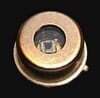
Thermopile Detector for Gas Analysis Dexter Research - Gas Analysis Thermopile Detector. Applications: Excellent for gas analysis, position sensor, and horizon sensor. A four-channel silicon-based thermopile in a TO-5 package. Each small active area is 1.2mm x 1.2mm . Time constant of 25ms with Nitrogen encapsulation gas. Delivers a very low Temperature Coefficient of Responsivity of -0.04%/ C. This detector has a very short thermal shock response to ambient temperature change. View additional information... Leader in Infrared... (read more) -
Dexter Research Center, Inc.
Gas Analysis...Thermopile Detector Dexter Research Center, Inc. A four-channel silicon-based thermopile in a TO-5 package. Each small active area is 1.2mm x 1.2mm . Time constant of 25ms with Nitrogen encapsulation gas. Delivers a very low Temperature Coefficient of Responsivity of -0.04%/ C. This detector has a very short thermal shock response to ambient temperature change. Features: A four-channel silicon-based thermopile in a TO-5 package. Each small active area is 1.2mm x 1.2mm . Time constant of 25ms with Nitrogen... (read more) -
Dexter Research Center, Inc.
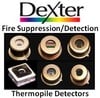
Thermopiles...Fire Suppression / Detection Dexter Research Center, Inc. - Fire Suppression / Detection - Thermopiles from Dexter Research. A variety of products based on yoour specific requirements (8 products): Attributes include: Thin Film vs Silicon, Signal to Noise Ratio (SNR), Package Type, Number of Channels and more. More Information... 1M Series - A thin film-based thermopile with a 1.0mm diameter active area with good signal-to-noise ratio in a TO-5 package and a moderate time constant of 32ms with Argon encapsulation gas. 2M... (read more)Browse Thermopiles Datasheets for Dexter Research Center, Inc. -
Dexter Research Center, Inc.
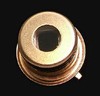
ST60 Silicon - Thermopile Detector Features: A single-channel silicon-based thermopile provides lowest cost solutions in a small active area of 0.61mm x 0.61mm in a TO-5 package. Time constant of 18ms with Nitrogen encapsulation gas. Delivers a very low Temperature Coefficient of Responsivity of -0.04%/ C. This detector has a very short thermal shock response to ambient temperature change. Applications: Excellent for non-contact temperature, fire suppression, horizon sensor, and gas analysis. Benefit: Low cost and small active... (read more)Browse Thermopiles Datasheets for Dexter Research Center, Inc. -
Dexter Research Center, Inc.
Thermopile Detector...excellent for gas analysis Dexter Research Center,Inc. - Offers extremely high output with best signal-to-noise performance with a time constant of 85ms when encapsulated with Argon gas. Excellent for gas analysis, fire detection and non-contact temperature measurement. Features: A thin film-based single element thermopile detector that offers the world's highest sensitivity in a TO-5 package. Dare to compare. Low noise voltage of 12.8nV/ Hz. Applications: Excellent for gas analysis, fire detection and non-contact... (read more)Browse Thermopiles Datasheets for Dexter Research Center, Inc. -
Dexter Research Center, Inc.
How Thermopile Detectors Factor Into Gas Analysis Gas analysis plays a crucial role in various scientific fields, from environmental monitoring to industrial processes, to ensure the health and safety of personnel and their working space. However, to accurately measure and analyze gases, reliable detectors are essential. One detector commonly used in gas analysis is the thermopile detector, which converts thermal energy into electrical energy. This blog post will explore how thermopile detectors factor into gas analysis and their significance... (read more)Browse Gas Sensors Datasheets for Dexter Research Center, Inc. -
Dexter Research Center, Inc.
Video: Solar, Temperature, and Power Measurement Thermopiles for Solar, Temperature and Power Measurement video. Dexter Research thermopiles are selectable over a wide spectral range, fast responding, and DC capable. All objects above absolute zero radiate electromagnetic energy. Our thermopile traps this energy and produces a voltage output proportional to the incident power without having to touch the object it is measuring. Power measurement thus becomes as simple as selecting a suitable optical or IR window to limit the incoming radiation... (read more)Browse Thermopiles Datasheets for Dexter Research Center, Inc. -
Dexter Research Center, Inc.
What if? A Question Dexter Answers Every Day What if? Let Dexter Research help you find the best solution -- it is what we do day-in and day-out. From either the perspective of systems performance or systems cost, customized applications of Dexter Research's thermopile technology continue to be the preferred solutions to today's burgeoning infrared detector market. However, we know that we cannot rest on our laurels and reputation. As a result, Dexter Research has undertaken an aggressive organization development program to support our... (read more)Browse Noncontact Infrared Temperature Sensors Datasheets for Dexter Research Center, Inc. -
Dexter Research Center, Inc.
Temperature Sensor Modules...Expanded Range accommodate systems with up to 100 modules. A wide variety of freezing/boiling prevention and alert systems are made possible thanks to a built-in thermal relay function. About Dexter Research - The World Leader in Infrared Thermopile Detectors: Dexter Research Center, Inc. was founded by Robert Toth, Ph.D in 1977. From either the perspective of systems performance or systems cost, customized applications of Dexter Research's thermopile technology continue to be the preferred solutions to today's... (read more) -
Dexter Research Center, Inc.
Expanded Ranges on our Temperature Sensor Module to a built-in thermal relay function. About Dexter Research - The World Leader in Infrared Thermopile Detectors: Dexter Research Center, Inc. was founded by Robert Toth, Ph.D in 1977. From either the perspective of systems performance or systems cost, customized applications of Dexter Research's thermopile technology continue to be the preferred solutions to today's burgeoning infrared detector market. Today, Dexter Research offers 31 core thermopile products, more than all global competitors... (read more)Browse Noncontact Infrared Temperature Sensors Datasheets for Dexter Research Center, Inc.
Conduct Research
Dexter Research Center is a leader in the manufacture of stable, high quality, high output radiation sensing thermopile detectors with a linear dynamic range from the UV to long wave IR. Thermopile detectors are passive radiation sensing voltage-generating devices, that require no bias or cooling...
The time constant of thermopile detectors can be determined by several methods depending on the specific waveform of the radiation used to excite the detector. If the detector is subject to a step function of radiation, its response follows the function below....
The selection of encapsulating gas in a thermopile detector package affects four important performance parameters: the output voltage, responsivity, signal-to-noise ratio (SNR) and time constant. Different gases have different molecular thermal conductivity. The molecular thermal conductivity...
To make a radiometric measurement with thermopile detectors, you will need to approximate the thermopile's cold junction temperature. Dexter offers optional externally mounted thermistors for all models as well as internally mounted thermistors on several of our models....
One of many applications of the thermopile detector is the remote measurement of temperature. In this Application brief we explain the basic principles of remote temperature measurement. Every object at temperature T (above absolute zero - 273.15 C) emits electro-magnetic radiation. The total...
The spectral bandpass of infrared radiometers using thermopile detectors are often controlled with a 6 um cut-on filter. These filters normally have a cut-on tolerance of +1 um and the cut-off wavelengths are determined by the substrate transmission, which is usually germanium or silicon...
The thin film thermopile detector like its forefather, the wire thermocouple, requires either a reference junction temperature measurement or a constant temperature sink for its reference junction. The later is usually difficult to implement in an instrument because of size and weight requirements...
More Information
 Indicates content that may require registration and/or purchase.

-
Total Infrared Detector Market Forecast to Grow at 16% CAGR to Top $381M in 2018
○ Main current pyroelectric and thermopile manufacturer production data .
-
Emerging Sensors Report - Handsets & Tablets - 2014
While the focus has been on microbolometer technology, IHS believes that thermopile manufacturers may be facing similar constraints.
-
REMS GTS: a pyrometer for Mars ground temperature measurement
Its value can be approximated by a polynomial expression provided by the thermopile manufacturer , which depends on Tcb.
-
Developing a Wireless Infrared Thermometer with a Narrow Field of View
Infrared thermopile ( manufacturer ) Field of view Wavelength pass (µm) Power consumption (sleep mode) a Resolution/Accuracy Cost of sensor module bα (Heimann) 10° 5.5 - 15 40 µA 0.1/±3.0°C from 0 to 55°C $175 β (Melexis) 10° 5.5 – 14 …
-
Comparison of Experimental Techniques for Measuring Isosteric Heat of Adsorption
The thermopile manufacturer (International Thermal Instruments Co.) claims that the signal is independent of temperature in a range from 0 to 250◦ C but information about the sig- nal at low temperature is unavailable.
-
A performance data network for solar process heat systems
thermopile manufacturer ’sspecified .
-
Ultraviolet radiometry of clinical sources with a miniature multijunction thermopile
Although the measurements in figure 4 indicated a linear response above 100mW cm-2, it is stressed that the 2M thermopile manufacturers specify this value of irradiance as the maximum incidence.
-
Thermoelectric micro devices: Interplay of highly effective thin film materials and technological compatibility
Therefore thermopile manufacturers do not invest into material quality improvements as the costs increase more than the device performance.
-
MEMS Market Tracker - Q3 2015
Market share in revenue of leading manufacturers of Thermopiles .
-
MEMS Market Tracker - Q4 2014
Market share in revenue of leading manufacturers of Thermopiles .