
Products & Services
See also: Categories | Featured Products | Technical Articles | More Information-
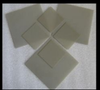
Description: Alumina substrate, also known as aluminum oxide substrate or ceramic substrate, is primarily composed of aluminum oxide (Al2O3). The excellent electrical, thermal, and mechanical characteristics of alumina, a well-known ceramic material, lead to its selection. The manufacturing
- Density: 3.6999976648298842 g/cc
- Max Use / Curie Temperature: 1,500 to 1,650 C
- Dielectric Strength: 17,000,000 V/m
- Material Type: Alumina / Aluminum Oxide, Silicon Carbide
-
Supplier: Accuratus Corporation
Description: pressing produces substrates up to 2 inches square and .250 inches thick. A list of standard substrate sizes can be found on the Aluminum Nitride Substrate Sizes page. Standard aluminum nitride process methods yield strong substrates with consistent material properties
- Thickness / Wall Thickness: 0.025 inch
- Length: 2 inch
- Diameter: 2 inch
- Density: 3.26 g/cc
-
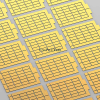
Description: DPC ceramic substrates are typically composed of aluminium nitride or alumina ceramic materials, to which a copper layer is directly bonded on one or both sides. DPC ceramic substrates are frequently used in applications like electronic packaging and power electronics because they are
- Specialty Ceramic Type: Aluminum Nitride
- Applications: Electrical / HV Parts, Electronics / RF-Microwave
- Performance Features: Metallized / Silvered (Electrode, Mirror)
- Features: Specialty Ceramic
-
-
Supplier: CoorsTek
Description: systems, such as: Altimeters L1 and L2 GPS RF Communications (UHF/VHF) Traffic Avoidance Collision Systems (TCAS) Broadband WiFi Ceramic Components for Antennas, RF, & Microwave Metallized Antenna Components Severe-service ceramic-metal and metallized antenna components and arrays
- Features: Specialty / Other
-
Description: Innovacera standard aluminum nitride wafer diameters are from 50.8 mm (2 inch) to 200 mm (8 inch) ; mostly use are 6" aluminum nitride wafers and 8" AlN wafer substrates . AlN Wafers can be produced in various thicknesses from 0.125mm to 1mm with polished or lapped sides, customized sizes or
- Specialty Ceramic Type: Aluminum Nitride
- Features: Other, Specialty / Other, Specialty Ceramic
- Shape / Form: Wafer / Substrate
-
Supplier: Polyflon Company - a Crane Co. Company
Description: Polyflon has taken advantage of the qualities of PTFE and coupled them with a proprietary plating process to produce a microwave substrate whose electrical performance cannot be equaled by any other substrate at this time.
-
Description: AlN substrate possesses a wide range of superior physical properties, including high breakdown electric field strength, thermal conductivity, resistivity, and so forth. In fields like LED packaging, power modules, wafer bonding, power resistors, and metalized substrates (such as thin
- Density: 3.2499979488370605 to 3.349997885724355 g/cc
- Max Use / Curie Temperature: 1,200 C
- Dielectric Strength: 17,000,000 V/m
- Specialty Ceramic Type: Aluminum Nitride
-
Supplier: Knowles
Description: High-K substrates are used for circuit miniaturization. DLI offers complete fabrication services!
- Length: 1 to 4 inch
- Width / O.D.: 1 to 4 inch
- Thickness / Wall Thickness: 0.025 inch
- Coeff. of Thermal Expansion (CTE): 0.55 to 10.1 µm/m-C
-
Supplier: 3X Ceramic Parts Company Limited
Description: process, alumina ceramic substrate are mainly used in high-tech fields, such as metallurgy, chemical industry, electronics, national defense, aerospace and nuclear technology. Alumina Ceramic Substrate Properties Alumina Ceramic Substrate is a kind of special ceramics, which has
- Density: 3.5999977279425903 to 3.8999975386044725 g/cc
- Material Type: Alumina / Aluminum Oxide
- Shape / Form: Bar Stock, Fabricated / Custom Shape, Rod Stock
- Applications: Electronics / RF-Microwave
-
Description: DBC (Direct Bonded Copper) is comprised of an insulating layer of ceramic substrate such as Al2O3 (aluminum oxide) and AlN (aluminum nitride) and copper connections to ensure electrical conductivity at high temperatures. For maximum reliability and performance, modules must exhibit excellent
- Features: Alumina / Aluminum Oxide, Specialty Ceramic
- Specialty Ceramic Type: Aluminum Nitride
- Applications: Battery / Fuel Cell, Construction & Building / Architectural, Electrical / HV Parts, Electronics / RF-Microwave
- Performance Features: Metallized / Silvered (Electrode, Mirror)
-
Description: process (below 300℃) guarantee the quality of ceramic and the metallized layer, also reduce the cost. Direct Plated Copper Substrate Applications:- High Power LED Packaging- Hybrid and electric automobile power management electronics- RF microwave communication- Substrates for
- Features: Other, Specialty / Other, Specialty Ceramic
-
Supplier: CoorsTek
Description: Ceramic print head substrates provide reliable long-life print performance for high-resolution printers. CoorsTek provides custom engineered components and precision assemblies for a wide variety of computer peripheral and data storage electronics. Advanced technical ceramics provide high
- Features: Dielectric / Electrical Insulation, Other
- Applications: Electronics / RF-Microwave
-
Supplier: APITech
Description: 2 to 40 GHz Ideal for broadband multiplexing Chebyshev and elliptic response Well suited for high shock and vibration applications Highly repeatable (ideal for matched filters) Broadband receivers Easily integrated with other components Design a Filter
-
Supplier: LG Chemical of America Inc.
Description: LCD Glass Substrate A key material for TFT-LCD LCD glass substrate is a thin glass board on which a thin circuit is deposited with precision. It is a key material for LCD. Ever since LG Chem ventured into the LCD market in 2009, it has remained fully committed to relentless research
- Applications: Electronics / RF-Microwave
- Shape / Form: Plate
-
Supplier: CoorsTek
Description: CoorsTek is the leader in custom and standard thin-film ceramic substrates. Four thin-film substrate material options combine smooth surface finish, strong flexural strength, and consistent electrical properties. Contact CoorsTek to help you design a specific thin-film substrate
- Thermal Conductivity: 26.6 W/m-K
- Coeff. of Thermal Expansion (CTE): 7 to 8.3 µm/m-C
- MOR / Flexural Strength: 85,861.8088994606 psi
- Modulus of Elasticity: 53,953,704.2408773 psi
-
Supplier: Samsung Electro-Mechanics
Description: Small body RF-SiP substrate Small body RF-SiP substrate Can realize ultrasmall substrates for communication module deivces, such as BAW/SAW filter, FBAR, and RF MEMS Ultrasmall substrates in the size of 0.7 ㎜ 1.0 mm are realized. Technology for
-
Supplier: CoorsTek
Description: CoorsTek developed the standards for thick-film ceramic substrates and continues to provide economical yet durable substrates for hybrid integrated circuits, surface mount devices, sensors, and other thick-film electronics. Why Ceramic Thick-Film Substrates? Alumina is the
- Thermal Conductivity: 26 W/m-K
- Coeff. of Thermal Expansion (CTE): 6.4 to 8.2 µm/m-C
- MOR / Flexural Strength: 58,014.7357428788 psi
- Modulus of Elasticity: 48,007,193.8272322 psi
-
Supplier: Anatech Electronics, Inc.
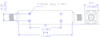
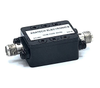
Description: 19500 MHz Suspended Substrate Low Pass Filter
- Frequency (Fc): 19,500 MHz
- Package Type: Connectorized
- Filter Type: Low Pass
- Features: Other
-
Supplier: Anatech Electronics, Inc.
Description: 12000 MHz Suspended Substrate Low pass filter
- Insertion Loss: 1 dB
- Package Type: Connectorized
- Filter Type: Low Pass
- Features: Other
-
Supplier: Anatech Electronics, Inc.
Description: 4.8 GHz Suspended Substrate High Pass Filter
- Frequency (Fc): 4,800 MHz
- Insertion Loss: 1 dB
- Package Type: Connectorized
- Filter Type: High Pass
-
Supplier: Anatech Electronics, Inc.
Description: 18 GHz – 40 GHz Suspended Substrate High Pass Filter
- Frequency (Fc): 18,000 MHz
- Insertion Loss: 2 dB
- Package Type: Connectorized
- Filter Type: High Pass
-
Supplier: Mini-Circuits
Description: Mini-Circuits’ Suspended Substrate Stripline filters offer low insertion loss by implementing printed circuit board suspended between two parallel ground planes, providing high Q. Low insertion loss combined with wide stop- band makes them an excellent choice for wideband instruments and
- Operating Temperature: -40 to 85 C
- Filter Type: Bandpass
-
Supplier: Mini-Circuits
Description: Mini-Circuits’ Suspended Substrate Stripline filters offer low insertion loss by implementing printed circuit board suspended between two parallel ground planes, providing high Q. Low insertion loss combined with wide stop- band makes them an excellent choice for wideband instruments and
- Insertion Loss: 2 dB
- Operating Temperature: -40 to 85 C
- Filter Type: Bandpass
-
Supplier: Mini-Circuits
Description: Mini-Circuits’ Suspended Substrate Stripline filters offer low insertion loss by implementing printed circuit board suspended between two parallel ground planes, providing high Q. Low insertion loss combined with wide stop- band makes them an excellent choice for wideband instruments and
- Operating Temperature: -40 to 85 C
- Filter Type: Bandpass
-
Supplier: Mini-Circuits
Description: Mini-Circuits’ Suspended Substrate Stripline filters offer low insertion loss by implementing printed circuit board suspended between two parallel ground planes, providing high Q. Low insertion loss combined with wide stop- band makes them an excellent choice for wideband instruments and
- Insertion Loss: 1 dB
- Operating Temperature: -40 to 85 C
- Filter Type: Bandpass
-
Description: importance of this technology as a fast and simple fabrication technique especially on flexible organic substrates such as Liquid Crystal Polymer (LCP) or paper-based substrates. Chapter three demonstrates several compact inkjet-printed UHF RFID antennas using antenna matching
-
Supplier: Richardson RFPD
Description: Flangeless Termination 125 Watts Features 125 Watts AlN Ceramic Substrate Non-Nichrome Resistive Element Low VSWR High power 100% Tested
- Power Rating: 125 watts
- VSWR: 1.25 :1
- Frequency Range: 3,000 MHz
- Features: Other, RF Terminator
-
Supplier: DigiKey
Description: PRINTED-SUBSTRATE
- Frequency Range: 40 to 1,000 MHz
- Minimum Operating Voltage: 24 volts
- Maximum Operating Voltage: 24 volts
- Nominal Operating Current: 0.245 amps
-
Supplier: DigiKey
Description: SUSPENDED SUBSTRATE HPF
- Frequency (Fc): 17,500 MHz
- Bandwidth: 13,000,000 kHz
- Insertion Loss: 2.5 dB
- Filter Type: High Pass
-
Supplier: Richardson RFPD
Description: The PE4140 is an ultra-high linearity passive broadband Quad MOSFET array with high dynamic range performance capable of operation beyond 6.0 GHz. This quad array operates with differential signals at all ports (RF, LO, IF), allowing mixers to be built that use LO powers from -7 dBm to +20
- RF Frequency Range: 0 to 6,000 MHz
- LO Frequency Range: 1,116 to 1,926 MHz
- IF Frequency Range: 1,062 MHz
- Conversion Loss: 6.5 dB
-
Supplier: Richardson RFPD
Description: The ADRF5424 is a reflective, single-pole double-throw (SPDT)switch manufactured in a silicon process attached on a galliumarsenide (GaAs) carrier substrate. The substrate incorporates thebond pads for chip and wire assembly, and the bottom of the deviceis metalized, connected to
- Frequency Range: 100 to 60,000 MHz
- Insertion Loss: 1.3 dB
- Isolation (Port to Port): 35 dB
- Switching Speed: 0.00001 ms
-
Supplier: Richardson RFPD
Description: The CHA2266 is a self biased, low-noise high gain driver amplifier. It is designed mainly for VSAT applications in Ku-band. The backside of the chip is both RF and DC grounded. This helps to simplify the assembly process. The circuit is manufactured on a standard GaAs PHEMT process, with via
- Frequency Range: 12,500 to 17,000 MHz
- Maximum Gain: 34 dB
- Output Power( P1dB): 14.5 dBm
- Noise Figure: 2.5 dB
-
Supplier: RIFTEK EUROPE Sp. z.o.o.
Description: The sensors are intended for non-contact measuring and monitoring the position of the edge (edges) of various objects, such as tapes, plates, substrates, etc.
- Range: 0.2755907 inch
- Display: Digital Display
- Measurement Scale / Units: Metric
- Gaging Technology: Non-contact, Optical
-
Supplier: DigiKey
Description: SUSPENDED SUBSTRATE DIPLEXER
- RX (Low): 0 to 20,000 MHz
- Device Type: Diplexer
-
Supplier: DigiKey
Description: NTN CERAMIC SUBSTRATE LOOP ANTEN
- Primary Frequency Range: 2,090 to 2,100 MHz
- Gain: 1.41 to 2.16 dB
- Form Factor / Mounting: Internal / Chip
- Polarization: Other












Find Suppliers by Category Top
Featured Products Top
-
 substrates are particularly valued in: Power Electronics: The high thermal conductivity and electrical insulation of AIN substrates are crucial in power electronic devices, where efficient heat dissipation and electrical isolation are required. RF and Microwave Devices: AIN’s low (read more)
Browse Specialty Ceramics Datasheets for Xiamen Innovacera Advanced Materials Co., Ltd. -
surface finish possibilities, board thickness considerations, wide ranges of reliability requirements, and even substrate-material choices. In addition, RF/microwave designs can require special manufacturing equipment. Fortunately, Summit has made significant investments in the equipment and field (read more)
Browse Printed Circuit Board (PCB) Fabrication Services Datasheets for Summit Interconnect -
designed for applications in harsh environments. Planar X Series provides system engineers with a high performance, compact solution for critical RF filtering in X band. The Planar X Series leverages thin film process technology on various substrates which are (read more)
Browse RF Low Pass Filters Datasheets for Smiths Interconnect, a Molex company -
of military and commercial aircraft, weapon systems, some U.S. Navy ships and NASA’s Space Shuttle fleet. Photochemical etching is a very effective solution for producing heat transfer and dissipation components that are used in applications including LED lighting, chilling systems, RF (read more)
Browse Datasheets for Conard Corporation (The) -
environment. EES are a class of passive metasurfaces that enhance wireless coverage at microwave and millimeter-wave frequencies via printed conductive patterns on substrates such as plastic or glass. When placed on a wall, window, or other structure, the scattering properties of (read more)
Browse Communications Software Datasheets for Remcom (USA) -
: High-power electronic packaging substrates RF and microwave insulator components Laser system heat management parts (read more)
Browse Industrial Ceramic Materials Datasheets for Shenzhen Great Precision Ceramic CO., LTD. -
substrates. Key Features and Benefits: Hermetic Seal Integrity: Helium leak rate (read more)
Browse Industrial Ceramic Materials Datasheets for Shenzhen Great Precision Ceramic CO., LTD. -
already meet the specification and testing requirements of MIL-PRF-55342. Tullio Panarello, Vice President and General Manager of the Fibre Optics and RF Components Business Unit at Smiths Interconnect said: “The HR TSX WB2 Series pushes the boundaries of Size (read more)
Browse Chip Resistors Datasheets for Smiths Interconnect, a Molex company
Conduct Research Top
-
Comparison of RF Terminations with BeO and ALN Substrates
Terminations designed to dissipate significant amounts of power at RF frequencies have traditionally been fabricated on beryllium oxide (BeO) substrates. The high thermal conductivity and moderate dielectric constant make BeO an ideal choice for this application. Increased regulation regarding
-
PTFE Microwave Substrates For Automotive Applications
With PTFE's low loss and stable Dk characteristics, its use as RF Microwave printed-circuit board (PCB) substrate is well-established. The growth in wireless-technology has by extension, driven the RF Microwave industry to design and develop lower-cost PCB substrates for the requirements of an ever
-
RF Power: GaN Moves In for the Kill
Is gallium nitride (GaN) the wide bandgap material that will turn RF power generation on its head and relegate gallium arsenide (GaAs) and LDMOS (Laterally Diffused Metal Oxide Semiconductor) to the annals of history? Well you'd certainly think so, based on articles in the trade press, symposium
-
How PTFE Can Compete With The Best In Thermosets
With PTFE's low loss and stable Dk characteristics, its use as RF Microwave printed-circuit board (PCB) substrate is well-established. The growth in wireless-technology has by extension, driven the RF Microwave industry to design and develop lower-cost PCB substrates for the requirements of an ever
-
RFID Battles the Elements
By Paul Thomas, Managing Editor Understanding how the elements might impact RF signals takes a bit of black magic, since little hard data exists, notes Bert Moore of IDAT Consulting (Atlanta). Often, the product is the problem. Geritol, he says, is not RF-friendly because of its high iron
-
Metrigraphics Article in Today's Medical Developments
. Then an electrolytic bath is used to deposit electroplatable metal onto a photographically-produced conductive patterned surface. Once the plating material has been built up - plated-up - to the desired thickness, the electroformed part is stripped away from the master substrate, yielding high-quality
More Information Top
 Indicates content that may require registration and/or purchase.

-
RF and Microwave Microelectronics Packaging
RF Substrate Materials Thermal and Electrical Properties . . . .
-
Substrate Noise Coupling in RFICs
The flow is used to develop a comprehensive RF substrate noise isolation design guide to be used by RF designers during the floor planning, circuit design and validation phases.
-
http://dspace.mit.edu/bitstream/handle/1721.1/87329/52060481-MIT.pdf?sequence=2
This research showed that the primary advantage of SOI in RF power applica- tions was the reduction of RF substrate loss due to the presence of the buried oxide.
-
The effect of low frequency pulse-shaped substrate bias on the remote plasma deposition of a-Si : H thin films
We have applied both sinusoidal and pulse-shaped rf substrate biasing techniques to the expanding thermal plasma deposition of hydrogenated amorphous silicon.
-
RF Performance of SOI CMOS Technology on Commercial 200-mm Enhanced Signal Integrity High Resistivity SOI Substrate
Due to their higher sensitivity to substrate effects at the SiO2/Si interface, CPW structures were built to investigate the RF substrate losses, true effective resistivity, and nonlinear behavior of both the eSI and HR-SOI substrates.
-
Physics of Semiconductor Devices
The RF substrate bias power supply is concurrently switched on.
-
Springer Handbook of Electronic and Photonic Materials
1278 55.6.1 RF Substrate Materials ...............
-
http://dspace.mit.edu/bitstream/handle/1721.1/38922/164876342-MIT.pdf?sequence=2
High-resistivity polycrystalline silicon as RF substrate in wafer- level packaging.
-
A Study on the Tuned Bias of Substrate in an Inductively-Coupled Plasma Source
Fig.6 Variation of tuned rf substrate DC bias volt- . age V,, with variable capacitance in the grounded upper . cover case. .
-
Dynamic potential formation of a rf sheath near the substrate in a dc discharge plasma
Here, we restrict ourselves to the sheath structure of the rf substrate in the absence of supplementary ionization, unlike the conventional rf electrode producing the plasma. .