
Milling Machines Information
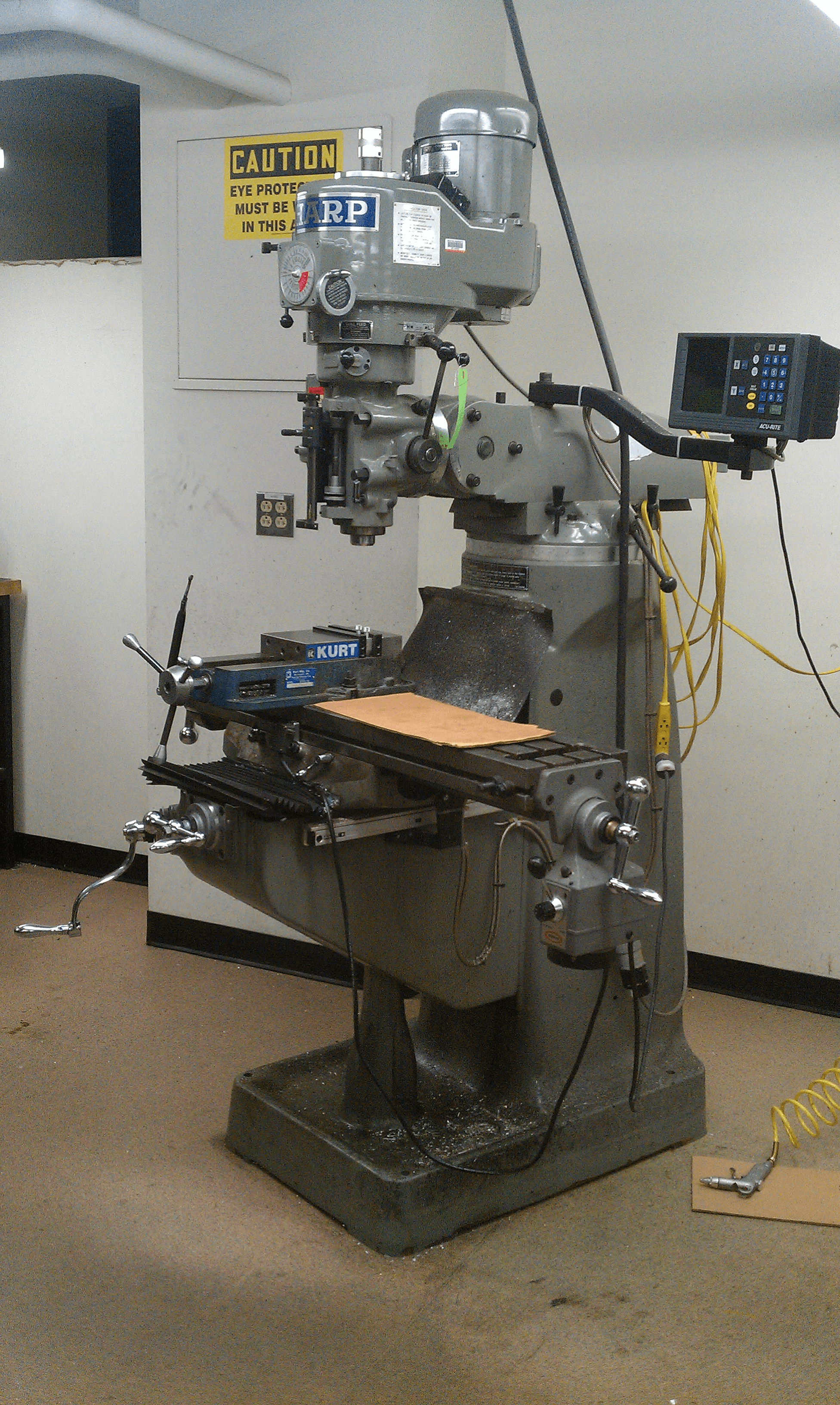 Milling machines move a workpiece into a fixed cutter, or a cutter into a stationary workpiece in vertical or horizontal directions along X, Y, and Z axes.
Types of Milling Machines
There are several basic types of milling machines:
- Vertical milling machines (VMC) have a vertical spindle, similar to the drill press, but with an X-Y table that permits positioning the work.
- Horizontal milling machines (HMC) also have an X-Y table for workpiece positioning; however, the cutters are mounted on a horizontal arbor across the table.
- Universal milling machines (UMC) can be used for either vertical or horizontal milling. The spindle head articulates to allow for either type of milling operation.
- Gantry milling machines are used with large workpieces. They allow for articulation of the spindle as needed for five-axis and six-axis milling machines.
- Machining centers are machine tools that are used to repeat operations automatically. Most machining centers are computer numerically controlled (CNC).
- CNC milling machines are programmed with a set of commands called G-codes and use CAT (V-Flange), BT, or HSK tooling.
Specifications
Milling machines carry specifications for spindle performance, movement, and table size. Spindle speed is the rotational speed range of the spindle head. Drive power is the rated power of the turbine, electric motor, or reciprocating engine that drives the spindle. The number of tools that the tool magazine supports is also an important consideration. Simple machines accommodate only one machine tool. Movement specifications for milling machines include:
- number of axes
- maximum X-axis travel
- maximum Y-axis travel
- maximum Z-axis travel
In terms of table size, the length of the table is measured parallel to the main axis of movement. The width of the table is measured perpendicular to the main axis of movement.
Features
Milling machines may include controls that support or include software packages for computer-aided design (CAD) or computer-aided manufacturing (CAM). Programmable machines can be set up for automated or semi-automated operations. Rotary tables allow rotation of the workpiece and provide travel along multiple axes. Milling machines with a cooling system are designed to prevent overheating and damage to the machinery during prolonged use. Suppliers who provide on-site calibration can help to ensure the precise operation of equipment. Some milling machines have a user interface with a digital readout. Others have an enclosure that houses the workspace. Vertical milling is more common than horizontal milling, largely because the workpiece is simple mounted. Horizontal milling is used if a large amount of material has to be removed, or there is less of a need for accuracy.
Related Information
CR4 Community—CNC Machines with PCB/Case Modification In Mind
CR4 Community—End Milling Resharpening Machine
Image credit:
BUEngineer / CC BY-SA 3.0
- Alabama
- Arizona
- California
- Colorado
- Connecticut
- Florida
- Georgia
- Iowa
- Illinois
- Indiana
- Kansas
- Kentucky
- Louisiana
- Massachusetts
- Maryland
- Maine
- Michigan
- Minnesota
- Missouri
- North Carolina
- New Hampshire
- New Jersey
- New York
- Ohio
- Oklahoma
- Oregon
- Pennsylvania
- South Carolina
- Tennessee
- Texas
- Virginia
- Vermont
- Washington
- Wisconsin
- Automatic Tool Changer
- Bed Mill
- Bench Mill
- Boring Mill / Jig Borer
- CAD / CAM Software
- Computer Numerical Control (CNC)
- Digital Readout
- Gantry / Double Column Machine
- High-speed Milling / Machining
- Horizontal
- Knee Mill
- Machining Center
- Manual
- Pallet Changer
- Rotary Table
- Spindle Cooling
- Universal
- Vertical
- Workspace Enclosure