
Low Light Cameras Information
086c0bb7193148d09f0bd419f2645b95.png "Image captured by low light security camera in near darkness")
Images credits: Archi Expo; SafeSecure; Blenheim Security
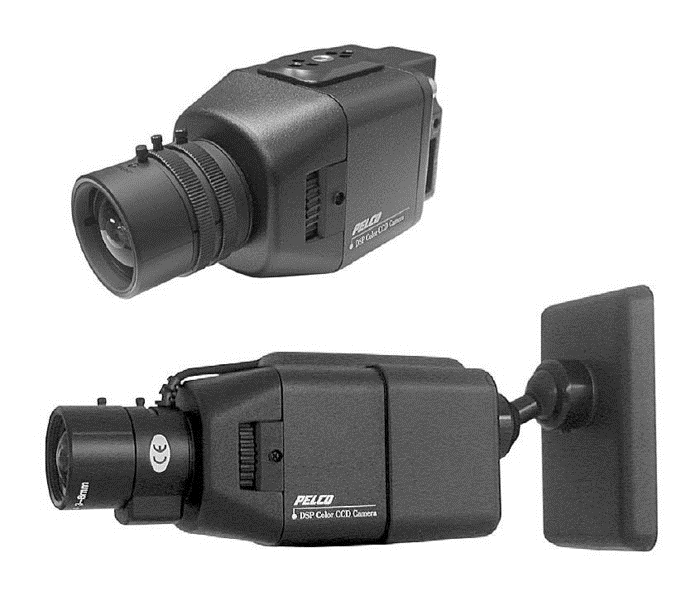
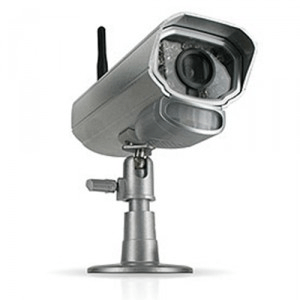
Low light cameras (sometimes called high sensitivity cameras) are a type of video camera with proprietary design features that enhance the capabilities of the camera to record in settings with little to no illumination. This is accomplished by the use of digital image sensors with remarkable sensitivity, which is the level of illumination required for good image quality. Low light cameras require even minimal levels of ambient light, so they should not be associated with night vision cameras.
Low Light Camera Operation
Low light cameras have the same basic function as regular video cameras: recording a rapid sequence of image stills that, when replayed successively, represent the translation of objects or people over time.
Yet low light cameras are optimized to function in situations where typical cameras fail: scenarios where darkness prevents the image sensor from electronically illustrating a scene. Low light cameras increase their sensitivity by one of two means: charge integration, or electron multiplication. Almost all low light cameras function with a CCD type image sensor, since CMOS technology is somewhat immature.
Charge Integration Low Light Camera
These types of low light cameras operate by increasing the available illumination to boost signal strength by extending the exposure time. However, this exposure rate greatly increases image noise that is resultant of the flow of dark current in the silicon on the image sensor. As such, cooling the sensor by 8° C will reduce the dark current noise by up to half. Cooling functions are typically provided by a Peltier element, but some industrial styles may use liquid nitrogen. These types of cameras are occasionally referred to as cooled CCD cameras.
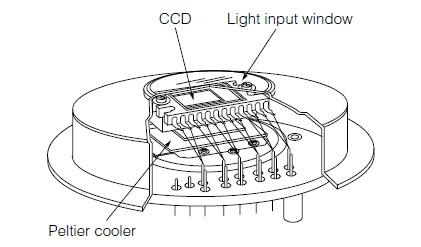
Image credit: Hamamatsu Photoniks K.K.
Electron Multiplication Low Light Cameras
-
SIT cameras (silicon intensified target) convert photons to electrons that are then accelerated by a voltage to hit the silicon where many electron-hole pairs are produced. The intensified charges from the silicon are then read by an electron beam to obtain a video signal. Compared to the subsequently mentioned ICCD camera, SIT cameras have less multiplication fluctuation of the image, but SIT cameras also are prone to spatial inaccuracies and incorrect hue intensities. Both of those problems can be corrected with image processing, however.
-
ICCD cameras (image intensifier CCD) gain their label from the use of an image intensifier on the front of the video camera. Intensifiers can be placed on the lens of any camera, but modern CCDs are specifically designed for intensifier integration. Photons are converted to electrons at a photocathode. The electron count is enlarged by the use of a microchannel plate, and the electrons are accelerated by a voltage in the microchannel plate. On average, one photon is recorded as 1,000 electrons after this process. ICCD cameras have an alternative method of operation called photon counting. In this process, a two-stage microchannel plate is used so the photon-to-electron charge has an amplitude large enough to be separated from the camera noise (which must be previously determined) by binary processing. The image then undergoes splicing and gravity detection, as illustrated below.
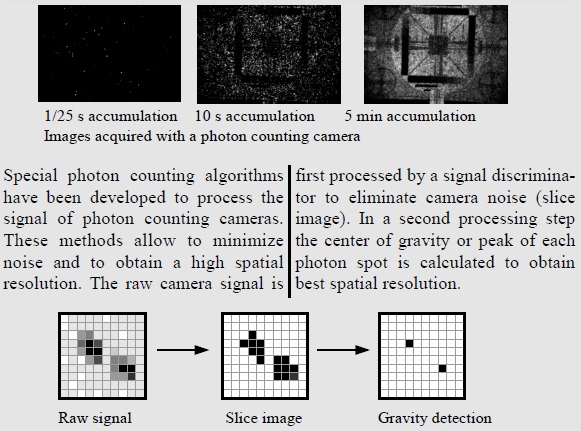
Image credit: Hamamatsu Photoniks K.K.
-
Electron bombardment CCD cameras (EB-CCD) also convert photons to electrons which are then accelerated by a voltage. The electrons collide with a back-thinned illuminated type of CCD, and the energy from the collision serves to multiply to electron register. One photon is capable of 1,200 electrons or output.
-
EM-CCD, the most recent version of low light cameras combines some elements of a cooled CCD with electron multiplication. An electron multiplier section, added to the last part of a frame transfer CCD camera, transfers electrons at a much higher voltage than normal. One electron will generate another electron at a low rate, but when repeated several hundred times the image can be intensified by as much as 2,000 times. An EM-CCD camera can be turned into a cooled CCD camera by reducing the gain and extending the exposure time. EM-CCD cameras should be cooled as well, since the camera needs to maintain a stable temperature as the gain rises. Scottish camera manufacturer Andor Technology has a comprehensive video regarding their EM-CCDs.
Video Camera Production
Video Quality
Lens
Regardless of the image capture method of the camera, the lens remains the most critical component regarding high-quality video capture. Lenses are meant to refine optical aberrations that occur when recording video, and there is a wide variety of camera lenses for various recording scenarios. Lenses come in several standard uses and mounting styles.
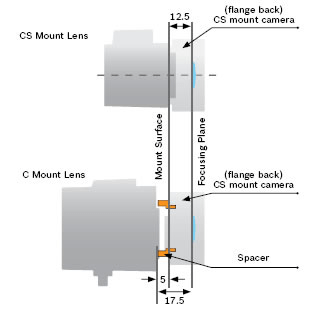
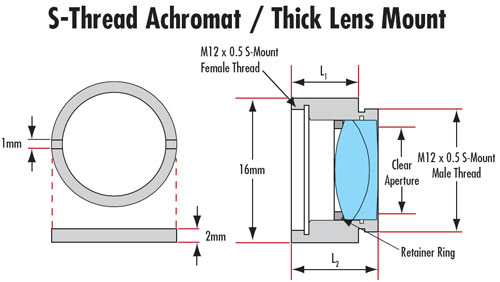
CS/C/S mount lenses
Image credit: Bosch Security; Wikipedia
-
C-mount lenses have a flange-back distance of 17.5 mm and are required for C-mount cameras. By comparison, CS-mount lenses have a flange-back distance of 12.5 mm. Because of their shorter back focal distance, CS-mount lenses cannot be used with C-mount cameras. C-mount features a diameter of 1" and a 32-thread per inch mounting thread.
-
CS-mount cameras can use both C-mount and CS-mount lenses; however, C-mount lenses require either a 5 mm adapter or adjustments to the CS-mount camera. Because of their shorter back focal distance, CS-mount lenses can be used only with CS-mount cameras. CS-mount features a diameter of 1" and a 32-thread per inch mounting thread.
-
S-mount is a smaller mounting configuration used in devices such as PC cameras and board-mounted cameras. S-mounts use a M12 x 0.5 threads.
-
An F-mount lens utilizes a bayonet-style mount standardized by Nikon.
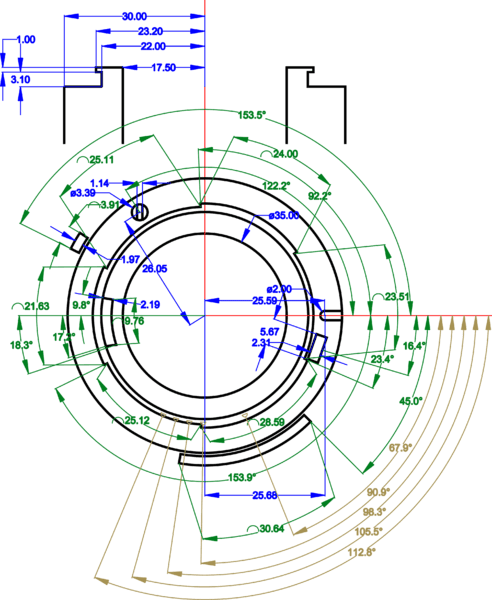
F lens mount dimensions
Image credit: Wikipedia
Resolution
Resolution is the quality of the image when viewed. For digital cameras, resolution depends upon the number of pixels (horizontally and vertically). At a standard size, more pixels sharpen details on a photograph, but when enlarged the pixels become apparent in an effect called pixelization. This is similar to grain on film. Digital camera resolution is commonly measured in megapixels (MPx), with each mega representing one million square pixels. High-definition is regarded as a resolution of 1,280 x 720 pixels or more.
Frame Rate
Measured in frames per second, this is the number of image captures. The human eye is capable of differentiating between 10 to 12 separate images per second; anything more and the rapidly changing images creates the illusion of movement. Frame rate of individual cameras is very much reliant upon the playback method and territory, or the specific application of the camera.
Low light cameras typically record within the range of 25—35 frames per second, which is the playback speed of video cameras in general.
Shutter Speed
This is responsible for the duration that light reaches the image sensor or film. It directly controls the exposure rate along with the aperture. Slower shutter speeds result in blurred motion capture. For low light cameras, especially charge integration style cameras, shutter speeds tend to be exceptionally long to allow the light intensity to be fully registered.
Video Playback
Low light cameras are typically manufactured for security applications (as outlined in the Video Camera Selection Guide); most video captured via low light cameras is displayed on a simple, black-and white monitor for live, remote monitoring. The video feed may be saved as additional file (VHS, MPEG, etc.) as well. Modern configurations may provide the video feed directly to computer interfaces for additional analysis and playback features.
Low Light Camera Specifications
Camera Mounting
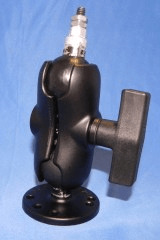
Camera positioning is accomplished by the use of various types of mounts, but many low light cameras with a specific purpose feature an integral mount (ex: low light cameras on automobile bumpers). Extendable and adjustable arms are common so cameras can be repositioned. Brackets are reserved for the most utilitarian of designs. Stands, such as unipods and tripods, offer a stable base while making the camera accessible to operators. Finally, many cameras come with the option of handheld or shoulder-mounted operation.
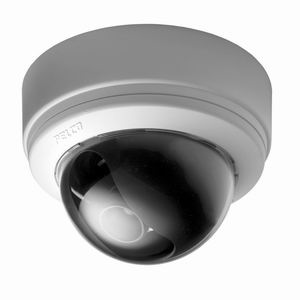
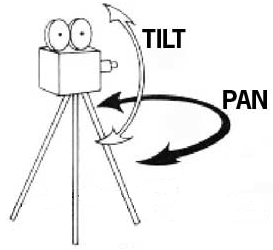
Security cameras are often mounted to a wall or ceiling by an adjustable arm bracket with standard hardware, providing pan and tilt functions. This eases their installation and increases their effectiveness. Security cameras can be mounted inconspicuously to record individuals surreptitiously, or prominently to deter misbehavior.
Industrial and scientific-based cameras are sometimes placed within a housing to protect the device from hostile environments. Industrial cameras are usually mounted with brackets or a separate type of mount that limits the device's movements. They also may provide resistance to mechanical vibration, which is common in manufacturing settings. Scientific cameras utilize whatever mount best suits the research, which may mean atypical placement. These mounts may apply by temporary means, may be exceptionally small, or the camera may not be mounted at all. Scientific cameras need the highest degree of flexibility among mounting options.
Instances of low light camera use for entertainment purposes are rare, but may be used intermittently to provide viewers a unique scene perspective. These cameras are almost always mounted in a stationary recording position--like a security camera, or are hand-held devices operated by the video subject.
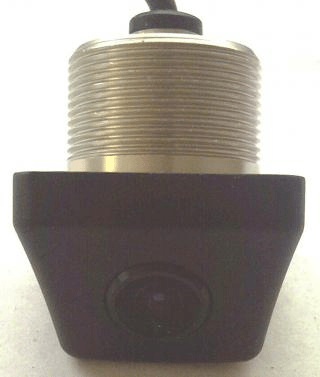
Images credits: Nav-TV; Nite Today
Camera Features
These specifications are often optional on video camera, but depending upon the use they will enhance video quality.
|
Anti-blooming before/after Image credit: Astrosurf
|
|
|
|
|
|
Image credit: Apstas |
|
Image credit: Jarrett Security
|
|
|
|
|
|
|
|
|
|
|
|
|
|
|
|
|
|
Image credit: Thermo Scientific
|
|
Image credit: JW Fisers
|
|
|
|
Image credit: Automation World |

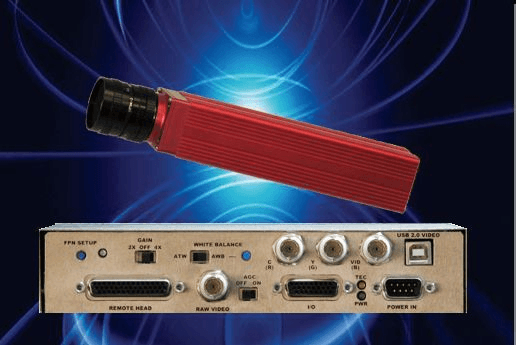
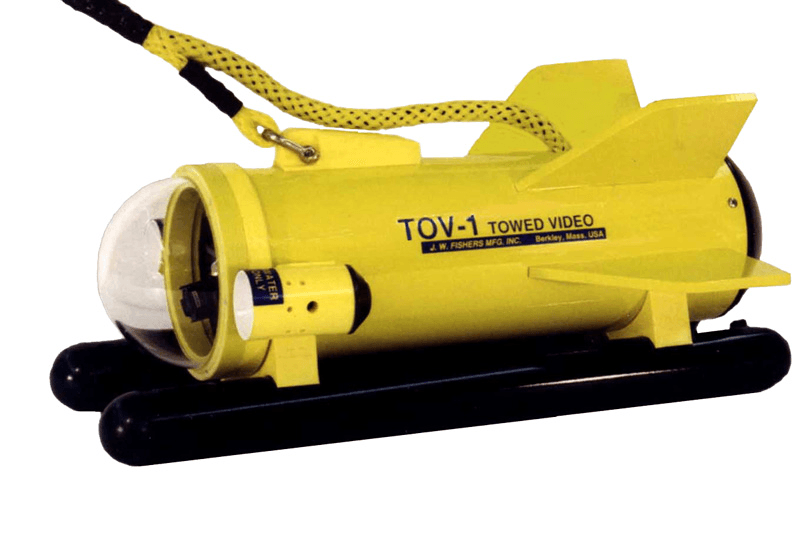
Low Light Camera Applications
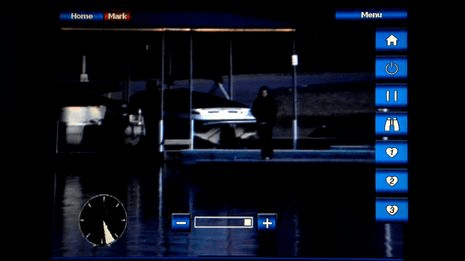
Low light cameras are frequently employed on vehicles to provide a reliable feed of dim roadways, waterways, and airstrips to their respective operators. While the most common industrial application would be night-time surveillance, they are also used in machine-vision applications with limited illumination. Traffic cameras are frequently cameras optimized to capture details--like license plates--in low light situations, as well as in-dash cameras used by police.
Scientific uses for low light cameras are extensive, from molecule detection and cell observation to astronomy and semiconductors. Animal research is a common and popular use of low light cameras.
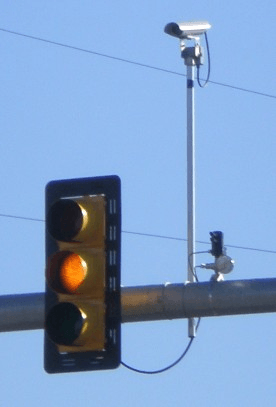
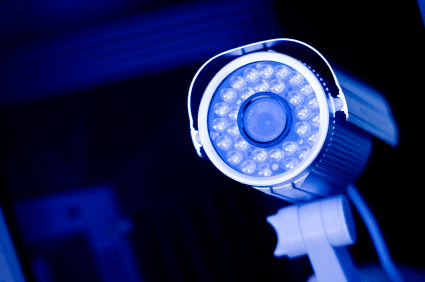
Images credits: Sporting Fish Mag; Escort Radar Forum; Family Home Security
Resources
PRLOG - Seeing in the Dark - Low Light vs Night Vision
Adept Turnkey Australia - Low light, High Sensitivity Cameras
Hamamatsu Photonics K.K. - High Sensitivity Cameras: Principal and Technology (.pdf); Luminescence Imaging Systems (.pdf)