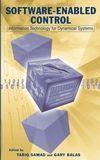
 This edited volume is the product of a research initiative undertaken by the
U.S. Defense Advanced Research Projects Agency (DARPA) and the U.S.
Air Force Research Laboratory (AFRL) to exploit recent developments in
software and computing technologies for applications to control systems
in general, and autonomous aircraft in particular. Control, in this context,
should not be interpreted in some narrow sense. Here it encompasses algorithms
for inner-loop regulation as well as supervisory and mission-level
optimization, modeling and estimation of vehicle dynamics and environmental
influences, real-time computing platforms and software design tools, and
much else besides.
The ‘‘Software Enabled Control’’ program is ongoing and the chapters in this volume do not
document the culmination of the research. But with some years of effort completed by a number
of multidisciplinary teams there is much to report: A number of innovations have resulted and been
validated through some combination of theoretical analyses, simulation experiments, and laboratory
demonstrations. In the near future, many of the developments detailed in this book are planned to
be further evaluated through flight testing.
The SEC program was envisioned and initiated at DARPA by Dr. Helen Gill and Dr. David
Tennenhouse and has subsequently benefited from the support and leadership provided by Dr.
Shankar Sastry and Dr. John Bay. At the U.S. Air Force Research Laboratory, Ray Bortner,
Bill Koenig, Reed Morgan, and Dale Van Cleave have been instrumental in overseeing the program
and its constituent projects. Todd Carr, Jessica Greenhalgh, Nikki Morris, and Carmen Whitson
have ably fulfilled a variety of coordination and administration responsibilities. We speak for the
SEC research community in expressing our gratitude to these individuals, and to several others
who were involved in advisory capacities, for creating and supporting this practically important and
intellectually exciting program.
| TARIQ SAMAD GARY BALAS | |
| Minneapolis, Minnesota October, 2002 |
 TABLE OF CONTENTS