12.5.3. Simulation Results
In this section, two example simulations are used to demonstrate the effectiveness
of the proposed architectures for adaptive limit prediction. In both
examples, Sigma-Pi neural networks are used in the adaptation loops. Initial
guesses needed for dynamic trim solutions are obtained using linear approximations
of Eq. (12.12).
Example 12.1: Linear Helicopter Model. A reduced-order linearized model
of a helicopter about the trim point at 85 knots forward flight is used in this
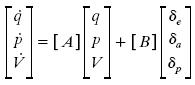
example. The selected reduced-order linearized model may be written as
where q is pitch rate, p is roll rate, and V is change in forward speed. δe, δa,
and δp are the longitudinal cyclic, lateral cyclic, and pedal deflections around
the initial trim point, respectively. In this example, p and q are the fast
states, and V is the slow state. The task is to estimate dynamic trim responses
on the pitch rate. Choosing the limit parameter vector to consist of the pitch
rate q, that is,
and using the sensor measurement for pitch, the architectures presented in
Figures 12.5 and 12.6 can be used for adaptive limit prediction of pitch rate.
Similar to Eq. (12.11), the following equation is used in the first adaptive
loop:
where
j = 1, 3, and

and

are known approximate estimate values of
a11
and
b1 j.The learning rate for the adaptive neural network (ANN1) was set at
300. The observability gain was chosen as
K = 2.5. The dynamic trim solution
is obtained using
The network gain for the second adaptive neural network (ANN2) was set at
15. In this example, the adaptive loops were turned on at 14 seconds into the
simulation. Figure 12.7 shows the pitch rate response, along with the estimated
response, and the dynamic trim predictions. The neural network
weights are initially set to zero and remain constant until the adaptive
algorithms are switched on. When adaptation is off, the observer follows its
own approximate dynamics, which at this phase is a linear model with the
approximate values and as parameters. It is seen in Figure 12.7 that,

prior to adaptation, the estimated response obtained using the approximate
model and the actual response are different. However, once the adaptive
loops are turned on, the estimated response matches very well with the
actual. Also, with adaptation the dynamic trim predictions are significantly
improved.
Example 12.2: Nonlinear Simulation of the XV-15 Tiltrotor. The push-up,
pull-over maneuver simulations using the XV-15 Generic Tilt-Rotor Simulation
model, GTRSIM, are considered in this example. The task is to estimate
the dynamic trim values of the load factor, g, and the corresponding control
margin for a specified load factor. In general, the load factor can be written
as a function of all fast and slow states, and control inputs. However, with the
assumption that there is a unique mapping between the fast states and the
load factor, an estimate of the load factor can be obtained using
| |  |
where τ is the approximate time constant associated with load factor dynamics
and Δ1 is model uncertainty approximated using an adaptive neural
network.
In this example, simulations were carried out at 153 knots forward speed,
for step inputs in the longitudinal cyclic pitch control. All other controls were
held constant at their original trim values. The purpose is to estimate the
limit control vector corresponding to a specified load factor limit. The load
factor upper and lower limits were set to +2.5g, -0.5g, respectively (see
Figure 12.8.. All adaptive neural network weights were initially set to zero.
The neural network learning rates were set at 150 for ANN1 and 25 for
ANN2 (both for upper and lower control margin calculations). The observability
gain was K = 10.
Figure 12.8 shows the control margin predictions with predefined upper
and lower limit margins. In the upper plot the actual load factor variation
(solid line) along with the upper and lower load factor limits ([-0.5g; +2.5g].
are shown. The lower plot shows the variation of longitudinal cyclic input
along with the upper and lower control limits corresponding to the selected
load factor limits. Note that a negative longitudinal input corresponds to a
positive load factor response. It is interesting to note that, as expected,
whenever the predicted peak load factor response is close to the specified
limits, the predicted control margin is small. For example, during 16-25 s,
the load factor reaches its upper limit and the upper control margin becomes
nearly zero. In fact, when the load factor exceeds the 2.5g limit around 37 s,
the upper control margin becomes negative. Note that the control margin
predictions have a similar lead time with respect to reaching a limit parameter
boundary.

© 2003

 This edited volume is the product of a research initiative undertaken by the
 TABLE OF CONTENTS