12.1. INTRODUCTION
Under the Software Enabled Control program sponsored by DARPA, the
Georgia Institute of Technology has been advancing technologies for unmanned
aerial vehicles (UAVs) that address issues of mode transitioning
control, limit checking and avoidance, and their implementation in an opencontrol
platform (OCP) [1]. Special emphasis in this project is placed on the
development of mid-level controllers combined with low-level flight controllers,
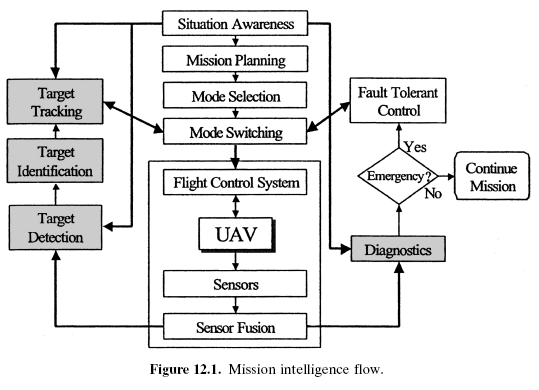
as depicted in the mission intelligence flow chart of Figure 12.1.
In this context, flight modes are selected in the high- and mid-level
modules of the control hierarchy and passed to the low-level controllers. The
low-level controllers are used to carry out these flight modes in a smooth,
stable, and safe way. The SEC program objectives include research products
that can enable autonomous vehicles to perform extreme maneuvers in highly
unstructured environments. Real-time mode transitioning and limit avoidance
technologies are called upon in such extreme-performance flight scenarios
if the vehicle is to meet mission objectives while maintaining its opera-
tional integrity. Both mode transitioning and limit avoidance scenarios may
be implemented in a complementary manner for a particular mission.
Complex large-scale systems such as unmanned aerial vehicles and industrial
processes are demanded to possess the intelligence required to behave
in an autonomous manner under uncertain environmental conditions. Typically,
these systems are required to operate in a finite number of operational
modes with robust, stable, and smooth transitions between them. A (local)
operational mode (or mode of operation.is considered to be a region in the
system’s state space in which the system exhibits quasi-steady-state behavior.
Thus, a mode is considered here to be a region of the state space around an
operating state associated with a local controller such that the combined
plant and controller maintains a stable behavior in the prescribed region. The
local controller must ensure the robust stability of the combined closed-loop
system for any trajectory within the mode. Different modes correspond to
disjoint regions of the state space. For example, in the UAV case, we define
such modes as hover, forward flight, and so on. A transition region between
two modes is a region of the state space consisting of all the systems states
not included in any local mode but in the trajectory connecting the modes.
A mode transition (or mode to mode) controller refers to a controller that
transitions a system from a start mode of operation to the goal mode. The
problem of transitioning between two operational modes can be solved by
nonadaptive techniques such as gain scheduling, sliding mode control, and
the method of blending local mode controllers. However, when the system to
be controlled differs significantly from the nominal system used in the design
methods above, degraded tracking performance of the desired transition
trajectory is to be expected.
Although there is no consistent theory that deals with dynamic transitions
between various equilibria, gain scheduling has been used to design equilibrium
to equilibrium controllers. The technique of gain scheduling constructs
a nonlinear controller by combining the members of an appropriate family of
linear controllers. In conventional gain scheduling, the transition between
equilibria is governed normally by an auxiliary scheduling variable [2,3] that
should vary slowly with respect to the states. The disadvantages associated
with gain scheduling include a reliance on a long trial-and-error design
process, a lack of adaptability to online variations, and poor robustness to
uncertainties [4]. The gain scheduling procedure is generally as follows [5]: (i)
Parameterize the equilibrium operating points of the plant by a scheduling
variable that involves some of the plant states; (ii) for a family of equilibrium
operating points parameterized by a scheduling variable, linear models of the
plant are created; linear controllers are obtained for each linear model; (iii)
finally, an interpolation technique is used to interpolate between the linear
controller gains for the equilibrium to equilibrium transition. Although gain-
scheduled controllers are typically designed using plant linearizations at a number
of equilibrium operating points, it is possible to apply gain scheduling to
control design of linear time-varying systems obtained via linearizations
relative to a trajectory [6,7]. To overcome the restriction to near-equilibrium
operation in traditional gain scheduling, a velocity-based gain-scheduling
controller design has been developed [8]. This method uses plant dynamics at
equilibrium and non-equilibrium operating points, which may lead to controller
realizations that achieve better performance than classical gain-scheduling
controllers.
Similar to gain scheduling, sliding mode control (SMC) uses more than
one control law and is, in general, nonlinear. The performance index is
specified as a manifold of the state space called the sliding surface. A sliding
mode controller sends the system states onto the sliding surface and keeps
them there. However, due to high control gain, SMC systems can suffer from
the effects of actuator chattering due to switching and imperfect implementations
[9]. When using SMC to track a desired trajectory, it may become
possible for the closed-loop system to become unstable if the sliding surface
changes faster than the SMC can follow it. In order to overcome the
disadvantages of the SMC systems, the fuzzy sliding mode control (FSMC)
has been introduced to provide better damping and reduced chattering [9].
The FSMC has been used for motion trajectory control in reference 10. In
reference 11, FSMC is used with a fuzzy logic controller in order to track a
prespecified position-velocity trajectory for an uncertain nonlinear system.
The basic objective of adaptive control is to maintain consistent performance
of a system in the presence of uncertainty or unknown variation in
plant parameters. Typically, adaptive control is developed for MIMO linear
systems, SISO nonlinear systems, and certain classes of MIMO nonlinear
systems. In reference 12, adaptive controllers were developed for a class of
feedback linearizable nonlinear systems. In reference 13, an adaptive output
feedback tracking control was proposed for a class of single-input singleoutput
nonlinear systems with uncertain differentiable time-varying parameters.
Recently, adaptive techniques based upon the one-step-ahead control
strategy have been developed for more general nonlinear systems. In reference
14, neural-network-based one-step-ahead control strategies were proposed
for a class of nonlinear SISO systems. In reference 15, a nonlinear
one-step-ahead control scheme based upon a recurrent neural network
model was proposed for nonlinear SISO processes. The neural network
model was trained via a recursive least-squares (RLS) algorithm, and the
gradient descent update rate for the control law was determined by stability
considerations. Finally, for a general class of MISO nonlinear systems, an
adaptive quasi-one-step-ahead control law was proposed in reference 16. The
control law was derived using the sensitivity between the controlled system
input and output and the quasi-one-step-ahead predictive output. The sensitivity
of the plant was estimated using RLS and the predictive output was
obtained by a recurrent neural network.
A continuous knowledge of ‘‘how far’’ the vehicle is from its structural
limit boundaries is needed by the low-level controller for safe maneuvering of
the vehicle. Controller commands need to be modified automatically, if a ‘‘fly
safe’’ region violation in the flight envelope is foreseen. This will guarantee a
safe flight, regardless of the commands from the high- and mid-level controller
blocks in the chain. Neural networks have been shown to be promising
tools for mapping of complex flight envelope limits as functions of flight
condition and control inputs [17]. Similarly, piloted simulations of tactile
cueing systems have been conducted using neural-network-based predictions
for limit avoidance [17]. However the application of these techniques to
adaptive flight control systems is a new area that needs to be fully exploited.
© 2003

 This edited volume is the product of a research initiative undertaken by the
 TABLE OF CONTENTS