 Preface
The key objectives in telecommunications—wired, wireless, or
optical—are safe and cost-effective transportation and prompt
delivery of the client’s undamaged data. How this is done, and
what technology is used to do it, is of less concern to the paying
customer and of more concern to us, the telecommunications
technologists. As an example, when we ship a box with some
goods in it, we never ask about the specifications of the trans-
portation equipment. We ask when it will be delivered and how much it costs, with
assurance that it will be delivered undamaged.
Having said that, in megatransportation modern telecommunications systems
that transport aggregate information at terabits per second, the safe and intact delivery
of client’s data must be guaranteed. However, unlike boxes that can be seen and
touched, data are flowing at the speed of light and in massive quantities. Therefore,
corrective mechanisms must be built in at the receiver end that verify the proper delivery
of data at an unprecedented quality level—one failure or less in
100,000,000,000,000 bits delivered.
DWDM (Dense Wavelength Division Multiplexing), like many differently colored
threads brought together to a thin rope, is a relatively new technology that enables
bandwidth scalability to levels not possible before. The receiving end performs
the reverse function; it unravels the rope to its constituent colored threads.
Each of these “threads” is modulated to bit rates up to 40 GHz, and, thus, the potential
aggregate bandwidth in a single strand of fiber is currently in excess of peta-bits
per second* (1 Pbit/s = 1,000,000,000,000,000 bits) and at distances over hundreds
of kilometers. As such, the sophistication of the data path as well as of the receiving
end cannot be overemphasized.
An information channel that is realized with a modulated optical frequency or
wavelength is termed an optical channel. However, as many optical channels travel
in a fiber strand, many interesting phenomena take place. Light interacts with mat-
ter, which interacts with light, and, as a result, although the transmitted signal was
of high quality, the received signal may have been contaminated. Therefore, the
amount of signal contamination needs to be estimated, monitored, and detected at
the receiver so that the actual signal performance can be compared with the expected
(one out of 10-12) and, if it does not meet this criterion, then some remedial action
must be taken based on recovery and protection strategies that are built into the
system and network.
This is the second book on performance of optical channels, systems, and networks.
The first book was Fault Detectability in DWDM: Towards Signal Quality
and System Robustness (IEEE Press, 2001). This is also the fifth book on DWDM.
The first book, DWDM Networks, Components and Technology (Wiley/IEEE 2003)
provides a comprehensive treatment, with focus on the DWDM networks and how
DWDM technology is employed in advanced optical systems and networks. Introduction
to DWDM Technology: Data in a Rainbow (IEEE Press, 2000) provides an
insight into the working of optical technology and an introduction to DWDM systems
and networks. Fault Detectability in DWDM provides a treatise on fault mechanisms
of DWDM components, systems, and networks and how they correlate and
are detected. Next Generation SONET/SDH: Voice and Data (Wiley/IEEE 2004)
provides a description of the next generation DWDM-based optical network and the
protocols that make possible voice and data convergence over the same optical network.
Understanding SONET/SDHand ATM: Communications Networks for the
Next Millennium (IEEE Press, 1999) provides a description of the legacy
SONET/SDH and ATM networks and protocols.
The objective of this book goes beyond describing optical components and their
parameters, systems, and networks. The main objectives are to describe sources that
affect the quality of optical signal and to provide the theoretical foundation on
which the signal quality at the receiver and the performance of the optical channel
are estimated, monitored, and detected. This book treats optical channels as memory-
less and the signals as modulated with the most traditional on-off technique;
channels with memory or multilevel modulation that are applicable to other transmission
media are the subject of other textbooks and also of current research. With
this objective in mind, this book reviews the fundamentals of optical communications,
including modulation, the fiber as an optical transmission medium, the receiver
and transmitter, jitter, and wander. It discusses factors affecting the signal
quality and sources of optical noise and jitter, and how they affect the optical signal
and the optical signal to noise ratio (OSNR). It clarifies the meaning of errored bits
and defines bit error ratio and rate, and optical bit error rate (OBER). It discusses
noise sources at the receiver, it provides a probabilistic and statistical analysis of errored
bits, and links BER with SNR. It describes the eye diagram as a visualizing
tool that quantifies the quality of the received signal, describes eye-diagram statistical
sampling, and how BER, Q-factor, and SNR are estimated from it. It also presents
a cost-efficient method for the automatic estimation of BER, Q-factor, and
SNR using integrated circuitry at the receiver. This book also reviews forward error
correction coding (FEC) methods, and how FEC and the estimation methodology
can work together to achieve better performance.
Throughout this book there are numerical examples for pedagogical purposes.
However, the real value of examples cannot be properly appreciated unless one is in
a position to visualize the impact of changing parameters on the quality of the signal
and quality of optical transmission. This book bridges this void by including a
CD-ROM that contains ten real-life exercises that can be simulated by the reader
(user, in this case) interactively. These problems are selected to cover a wide spectrum
of link-layer problems, from simple attenuation to dispersion and even forward
error correction. The objective of this CD-ROM and the ten problems that are
simulated are described in Appendix B.
As in the previous books, it is my hope that this book will excite many communications
engineers, system designers, and network architects and will stimulate
many questions relevant to optical communications from DWDM network and engineering
technologists as well as researchers wishing to go a step further into the
interesting field of channel characterization and signal quality assessment. It is my
hope that this excitation and stimulation will culminate in the design of more robust,
efficient, and cost-effective optical systems and networks. I wish you happy
and easy reading.
STAMATIOS V. KARTALOPOULOS, PH.D.
__________________
*Currently, terabits per second is reality. However, if the continuous spectrum from under 1300 to over
1600nm is deployed, and the channel separation is reduced, theoretically petabits per second will become
a reality of the future.
 TABLE OF CONTENTS
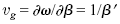
 denotes a partial derivative.