Applications of Robust Control to Nonlinear Systems

The H ? optimal control synthesis theory provides a direct method for achieving singular-value loop-shaping specifications. Consider the problem of designing a controller K( s) for a multivariable plant having the transfer function matrix G( s). The requirements for disturbance attenuation and robust stability can be specified by the weighting functions W 1( j ?) and W 2( j ?) as in7:
| (3.13) | |
| (3.14) | |
where ? c and ? c are the 0-dB crossover frequencies of the Bode plots of W l and W 2. The requirements stated in Eqs. (3.13) and (3.14) are within 3 dB, or within
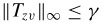
equivalent to
| (3.15) | |
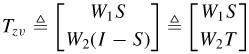
where
| (3.16) | |
| (3.17) | |
This control problem can now be formulated as the standard H ? optimization problem. In accomplishing this, the system representation is arranged as follows:
| (3.18) | |
where
G 11( s) ?
, G 12( s) ?
, G 21( s) ?
, G 22( s) ? ![]()
Here, ?( s) h l is the set of h x l proper rational matrices with real coefficients. In Eq. (3.18), z, y, v, and u are the controlled output, the measured output, the exogenous input, and the control input, respectively. The controlled output vector z usually includes the weighted error signal and a weighted control input. The exogenous input v contains...