Applications of Robust Control to Nonlinear Systems
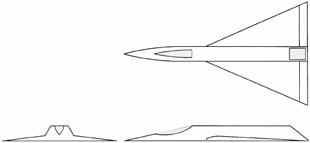
Using the nonlinear control system design techniques covered in this book, it is possible to modify the frequency as well as the damping characteristics of the nonlinear plant. The following example is the directional control system for the low-altitude/high-subsonic UAV shown in Fig. 7.1, whose flight condition parameters are listed in Table 7.1 (see Ref. 68). Directional control is achieved through differential deflection of a full span trailing edge elevon. In accomplishing this function the surface is used as a classical aileron. It will subsequently be referred to in this way.
| Altitude | = sea level |
| Mach | = 0.9 (a = 1116 fps) |
| ? | = 0.002377 slugs/ft 3 |
|
| = 1004.4 fps |
| q | = ?V 2/2 = 11991b/ft |
| ? trim | = 2 deg |
| ? 0 | = 2 deg |
| U 0 | = 1004 fps |
| W 0 | = 36 fps |
The commands to the aileron are either full up or down deflection, or trailing edge neutral. This type of system is often used in controlling low-cost UAVs because of its simplicity. A dead zone exists that reduces limit cycling and allows small commands due to either sensor noise or small perturbations to the vehicle to be ignored. The sensor is a simple ring laser gyro feeding attitude and rate information back to the nonlinear H ? optimized controller. The servo is modeled using a simple first-order lag. The roll dynamics of the UAV are likewise modeled using a first-order...