Applications of Robust Control to Nonlinear Systems

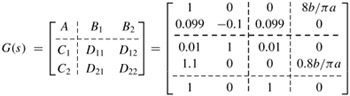
The example problem of Chapter 5, Sec. II, is solved directly in this chapter using a nonlinear extension to the method of Chang.56 The generalized plant of Eq. (5.8) is repeated here, along with appropriate dimensions:58
| (6.1) | |
| (6.2, 6.3, 6.4) | |
| (6.5, 6.6) | |
| (6.7, 6.8, 6.9, 6.10) | |
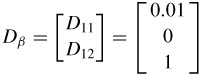
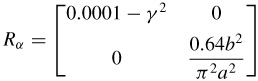
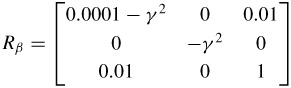
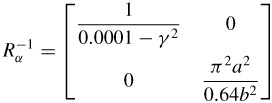
The solutions for the Riccati matrices X and Y will be derived next. First, the following intermediate matrices are calculated:58
| (6.11) | |
| (6.12) | |
| (6.13) | |
| (6.14) | |
| (6.15) | |
| (6.16) | |
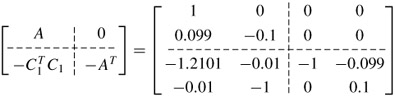
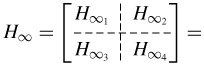
Next, when solving for the Hamiltonian matrix H ? additional intermediate matrices are generated:58
| (6.17) | |
| (6.18) | |
| (6.19) | |
| (6.20) | |
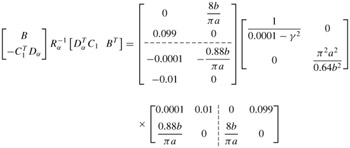
The first term in the H ? equation is
| (6.21) | |
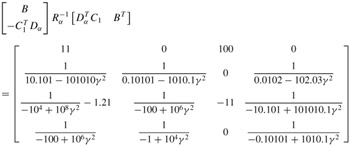
Similarly, the second term in the H ? equation is
| (6.22) | |
or
| (6.23) | |
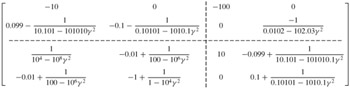
Subtracting Eq. (6.23) from Eq. (6.21) gives the Hamiltonian matrix H ? of Eq. (6.25):
| (6.24) | |
| (6.25) | |
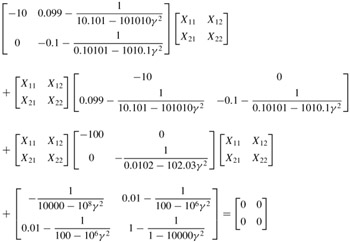
The corresponding Riccati equation is
| (6.26) | |
or
| (6.27) | |
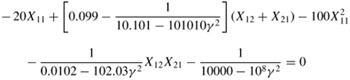
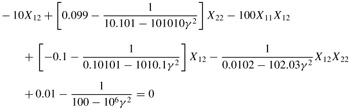
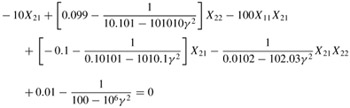
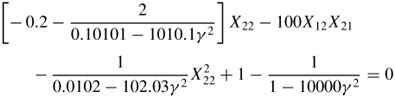
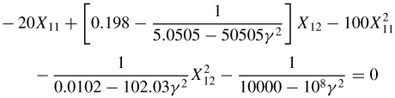
Equation (6.27) is equivalent to the following four equations:
| (6.28) | |
| (6.29) | |
| (6.30) | |
| (6.31) | |
Subtracting Eq. (6.30) from (6.29) gives X 12 X 21 = 0, or X 12 = X 21. Equations (6.28 6.31) simplify to become
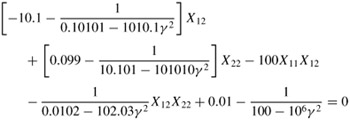
| (6.32) | |
| (6.33) | |
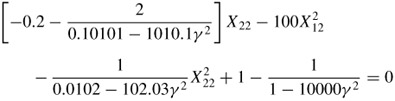
| (6.34) | |
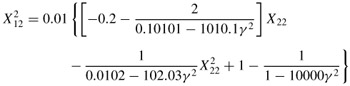
Solving for X 12 in Eq. (6.34) gives
| (6.35) | |
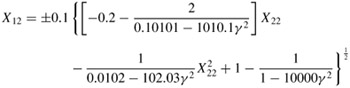
or
| (6.36) | |
To generate the solution for the Riccati matrix X, first solve for X 11 = f( X 12) using Eq. (6.32), then solve for X 22