Applications of Robust Control to Nonlinear Systems

The following sections cover the computer algorithms used in developing the work contained within this book.
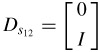
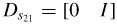
Using the formulation for the H ? optimization problem from Chapter 3, Section II, the optimal H ? norm and the optimal or suboptimal H ? controller can be computed. It is assumed that D 12 is of full column rank, and that D 21 is of full row rank. The inputs and outputs are scaled so that the assumptions D 21 = [0 I] and D 12 = [0 I] T are satisfied.13
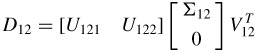
Step 1: Compute the singular value decomposition for D 12 (see Ref. 9).
| (8.1) | |
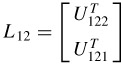
Define:
| (8.2) | |
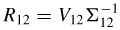
and
| (8.3) | |
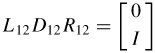
Then:
| (8.4) | |
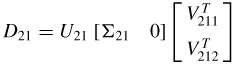
Step 2: Compute the singular value decomposition for D 21 (see Ref. 9).
| (8.5) | |
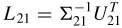
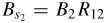
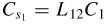
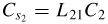
Define:
| (8.6) | |
and
| (8.7) | |
Then:
| (8.8) | |
Step 3: Scale the inputs and outputs.56
Define the scaled inputs v s, u s, and the new outputs z s, y s as follows:
| (8.9) | |
| (8.10) | |
| (8.11) | |
| (8.12) | |
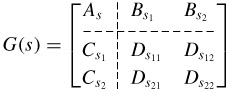
The new generalized plant G( s) (i.e., the transfer function from [
] to [
] has the following state space realization:
| (8.13) | |
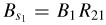
where
| (8.14) | |
| (8.15) | |
| (8.16) | |
| (8.17) | |
| (8.18) | |
| (8.19) | |
| (8.20) | |
| (8.21) | |
| (8.22) | |
An optimal (or suboptimal) controller is then generated based on the scaled generalized plant G( s). By definition, this controller has...