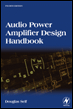
Audio Power Amplifier Design Handbook, Fourth Edition
Chapter 4: The Small Signal Stages

'A beginning is the time for taking the most delicate care that the balances are correct.' Frank Herbert, Dune.

The Role of the Input Stage

The input stage of an amplifier performs the critical duty of subtracting the feedback signal from the input, to generate the error signal that drives the output. It is almost invariably a differential transconductance stage; a voltage-difference input results in a current output that is essentially insensitive to the voltage at the output port. Its design is also frequently neglected, as it is assumed that the signals involved must be small, and that its linearity can therefore be taken lightly compared with that of the VAS or the output stage. This is quite wrong, for a misconceived or even mildly wayward input stage can easily dominate the HF distortion performance.

The input transconductance is one of the two parameters setting HF open-loop (o/l) gain, and therefore has a powerful influence on stability and transient behaviour as well as distortion. Ideally the designer should set out with some notion of how much o/l gain at 20 kHz will be safe when driving worst-case reactive loads (this information should be easier to gather now there is a way to measure o/l gain directly) and from this a suitable combination of input transconductance and dominant-pole Miller capacitance can be chosen.

Many of the performance graphs shown here are taken from a model (small-signal stages only) amplifier with a Class-A emitter-follower output, at +16 dBu on 15V...

UNLIMITED FREE
ACCESS
TO THE WORLD'S BEST IDEAS

SUBMIT
Already a GlobalSpec user? Log in.

This is embarrasing...

An error occurred while processing the form. Please try again in a few minutes.

Customize Your GlobalSpec Experience

Category: Operational Transconductance Amplifiers (OTA)
Finish!
Privacy Policy

This is embarrasing...

An error occurred while processing the form. Please try again in a few minutes.