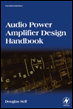
Audio Power Amplifier Design Handbook, Fourth Edition
The two salient facts about Class-A amplifiers are that they are inefficient, and that they give the best possible distortion performance. They will never supplant Class-B amplifiers; but they will always be around.
The quiescent dissipation of the classic Class-A amplifier is equal to twice the maximum output power, making massive power outputs impractical, if only because of the discomfort engendered in the summer months. However, the nature of human hearing means that the power of an amplifier must be considerably increased to sound significantly louder. Doubling the sound pressure level (SPL) is not the same as doubling subjective loudness, the latter being measured in Sones rather than dB above threshold, and it appears that doubling subjective loudness requires nearer a 10 dB rather than 6 dB rise in SPL[1]. This implies amplifier power must be increased something like ten-fold, rather than merely quadrupled, to double subjective loudness. Thus a 40 W Class-B amplifier does not sound much larger than its 20 W Class-A cousin.
There is an attractive simplicity and purity about Class A. Most of the distortion mechanisms studied so far stem from Class B, and we can thankfully forget crossover and switchoff phenomena (Distortions 3b, 3c), non-linear VAS loading (Distortion 4), injection of supply-rail signals (Distortion 5), induction from supply currents (Distortion 6), and erroneous feedback connections (Distortion 7). Beta-mismatch in the output devices can also be ignored.
The only real disadvantage of Class-A is inefficiency, so inevitably efforts have been made to...