Audio Power Amplifier Design Handbook, Fourth Edition
Output Networks

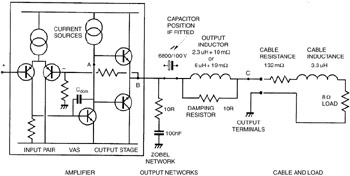
The usual output networks for a power amplifier are shown in Figure 7.6, with typical values. They comprise a shunt Zobel network, for stability into inductive loads, and a series output inductor/damping resistor for stability into capacitive loads.


Figure 7.6: The amplifier-cable-speaker system. Simplified amplifier with Zobel network and damped output inductor, and a resistive load. Cable resistance and inductance values are typical for a 5 m length

Amplifier Output Impedance

The main effect of output impedance is usually thought to be its effect on Damping Factor. This is wrong, as explained in Chapter 1. Despite this demonstration of its irrelevance, I will refer to Damping Factor here, to show how an apparently impressive figure dwindles as more parts of the speaker-cable system are included.

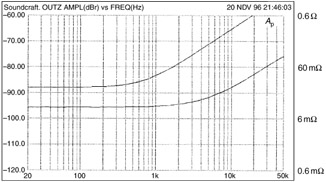
Figure 7.6 shows a simplified amplifier with Zobel network and series output inductor, plus simple models of the connecting cable and speaker load. The output impedance of a solid-state amplifier is very low if even a modest amount of global NFB is used. I measured a Blameless Class-B amplifier similar to Figure 7.5 with the usual NFB factor of 29 dB at 20 kHz, increasing at 6 dB/octave as frequency falls. Figure 7.7 shows the output impedance at point B before the output inductor, measured by injecting a 10 mA signal current into the output via a 600 ? resistance.


Figure 7.7: Output impedance of a Blameless amplifier, with and without 6 ?H output inductor. Adding the inductor (upper trace) increases...

UNLIMITED FREE
ACCESS
TO THE WORLD'S BEST IDEAS

SUBMIT
Already a GlobalSpec user? Log in.

This is embarrasing...

An error occurred while processing the form. Please try again in a few minutes.

Customize Your GlobalSpec Experience

Category: IC Electronic Filters
Finish!
Privacy Policy

This is embarrasing...

An error occurred while processing the form. Please try again in a few minutes.