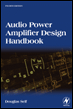
Audio Power Amplifier Design Handbook, Fourth Edition
Amplifiers are almost universally designed and tested running into a purely resistive load, although they actually spend their working lives driving loudspeakers, which contain both important reactive components and also electromechanical resonances. At first sight this is a nonsensical situation; however, testing into resistive loads is neither naive nor an attempt to avoid the issue of real loads; there is in fact little alternative.
Loudspeakers vary greatly in their design and construction, and this is reflected in variations in the impedance they present to the amplifier on test. It would be necessary to specify a standard speaker for the results from different amplifiers to be comparable. Second, loudspeakers have a notable tendency to turn electricity into sound, and the sinewave testing of a 20O W amplifier would be a demanding experience for all those in earshot; soundproof chambers are not easy or cheap to construct. Third, such a standard test speaker would have to be capable of enormous power-handling if it were to be able to sustain long-term testing at high power; loudspeakers are always rated with the peak/average ratio of speech and music firmly in mind, and the lower signal levels at high frequencies are also exploited when choosing tweeter power ratings. A final objection is that loudspeakers are not noted for perfect linearity, especially at the LF end, and if the amplifier does not have a very low output impedance this speaker non-linearity may confuse the measurement of distortion. Amplifier testing would...