Communication in Organisations CMIOLP

In the 1950s, Eric Berne developed the theory of Transactional Analysis . [1] He believed that each person's personality is made up of the following states of mind:
Adult
Parent (learned from their parents or parental substitutes)
Child (learned as a child).
During the course of a conversation or transaction everyone has the potential to adopt the corresponding behaviour for the different states of mind.
Behaviours associated with each state of mind are as follows:
| You can be in the state of mind of | Associated behaviours |
|---|---|
| An adult | Thoughtful, making rational judgements and responding accordingly |
| A parent | Behaviours are associated with either the:
|
| A child | Behaviours can result from the:
|
What state of mind is the most conducive to good working relationships?
FEEDBACK
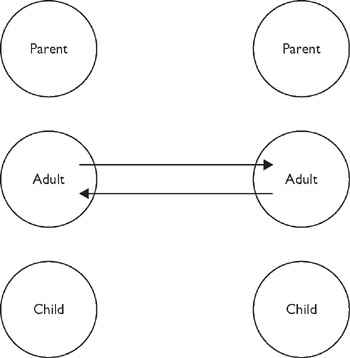
Interactions between adult states give the most effective working relationships. Berne refers to this type of transaction as being complementary , i.e. the response follows the pattern of a healthy human relationship. For example:

Other types of complementary transactions include parent parent, or parent child, which, at times, may play a useful function in the workplace.
Difficulties arise when the states of mind adopted are crossed rather than being complementary.
Consider the following conversation and identify the states of mind of...