Nuclear Safety

15-2: Reference ground motion

15-2 Reference ground motion

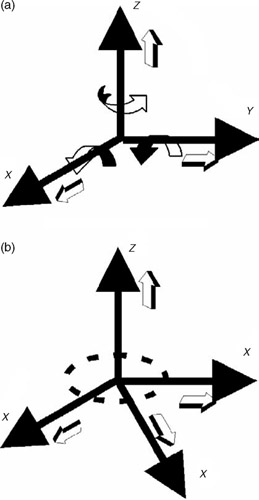
The seismic motion of a point in the ground is complex and motion along all six degrees of freedom take place (the three translation ones and the three rotation ones (Fig. 15-3)). Prof Gallardo de Salamanca (quoted above) reduced them to three principal ones: that is one of horizontal oscillation, one of vertical oscillation and one of rotation around a horizontal axis. In reality the horizontal oscillation and the rotation each count twice if they are applied to any direction in the horizontal plane.


Figure 15-3: The six real degrees of freedom and the three degrees generally used.

Today, we reduce the seismic reference motions to those which experience has indicated are generally prevailing in practice: a horizontal oscillatory translation (in the various possible directions) and a vertical one.

Even with this simplification, the problem of defining the seismic ground motion as an input datum in the seismic analysis of the plant is far from trivial: here too some conventionally accepted and usually conservative assumptions are necessary (Castellani et al., 2000; Roesset, 1995).

According to what we know today (which super- sedes the explosive model described by Gallardo), an earthquake is usually started by the sudden relative sliding of contiguous zones of the Earth's crust along fracture surfaces (faults), due to the internal state of stress of the ground itself. The accumulated elastic energy is then liberated in the surrounding medium producing compression and shear seismic waves which also become surface ones near the free...

UNLIMITED FREE
ACCESS
TO THE WORLD'S BEST IDEAS

SUBMIT
Already a GlobalSpec user? Log in.

This is embarrasing...

An error occurred while processing the form. Please try again in a few minutes.

Customize Your GlobalSpec Experience

Category: Seismic Instruments
Finish!
Privacy Policy

This is embarrasing...

An error occurred while processing the form. Please try again in a few minutes.