A10-1 Initial studies
The importance of a voluntary primary depressurization system in a PWR has been stressed many times in this book. It is an absolute requirement in a BWR in order to cope with the loss of the main condenser, given the fact that steam release to the outside is excluded for the radioactivity content of the reactor water.
A system of this type can have several configurations, but only one type (see Figure A10-1), the Core Rescue System (CRS), which was greatly studied between 1980 85, is described here.
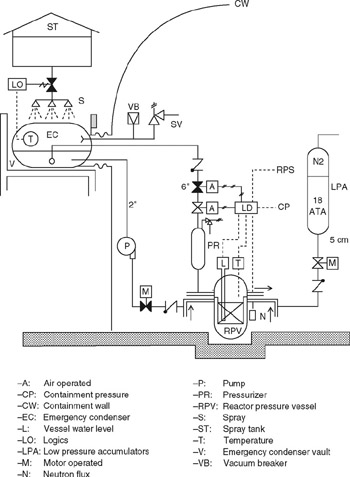 Figure A10-1: Core rescue system.
 This system was not only a primary depressurization system, as it also included a subsequent passive water injection function in the primary circuit (low pressure and small flow rate) for the long-term refrigeration of the core.
The degree to which the CRS was incorporated into plants depended on how far a particular plant design had progressed, ranging from being an integral part of the design from initial conception to being backfitted .
The system operation does not exploit gravity, which is the type to be preferred, and has been replaced, for the borated water injection (accumulators), by gas under pressure. In fact, where significant pressures are needed, gravity can only be employed on sites having a particular topography, as in the case of the SENA power station located inside a cavern in a hill (Chooz, Belgium).
Figure A10-1 shows the functional scheme of a CRS where, for clarity, the necessary redundancies of components are not indicated.


 TABLE OF CONTENTS