2.3.1 Uniqueness Theorem
The uniqueness theorem is the prerequisite for the application of most of the subsequent theorems, such as the equivalence principle, Huygens' principle, the image theorem, Babinet's principle, the induction theorem, etc. It indicates how a problem should be properly formulated in order to provide one and only one solution. In fact, uniqueness of the solution is a consequence of the proper imposition of the boundary conditions, since overdetermination, i.e. too many boundary conditions, may lead to no solution for a given problem, while a lack of boundary conditions may lead to multiple solutions.
For time-harmonic electromagnetic fields the uniqueness theorem states that when the sources and the tangential components of the electric or magnetic field are specified over the whole boundary surface of a given region, then the solution within this region is unique. This is actually true only if the medium is slightly lossy; otherwise it is possible to have a multiplicity of solutions as, for example, for a closed resonator.
The proof of the uniqueness theorem follows from considering two different solutions E1, H 1 and E2, H2 in the volume V bounded by the surface S excited by the same system of sources. Let us define the difference fields ? E and ? H as
| (2.68) | 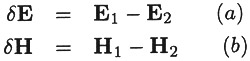 |
By linearity and since the sources are the same, the difference fields satisfy the source-free Maxwell's equations
| (2.69) | 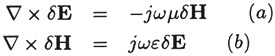 |
where it has been assumed that the permittivity e and...

 TABLE OF CONTENTS