Open Electromagnetic Waveguides

2.7: Plane Waves at Interfaces

2.7 Plane Waves at Interfaces

2.7.1 Snell's Law

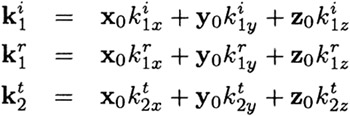
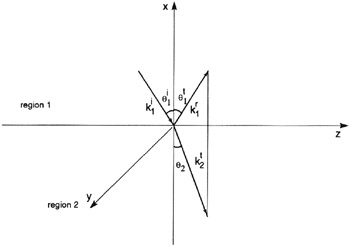
Consider a plane wave impinging on a surface between two media with different dielectric constants, as in Figure 2.31. In general, part of the incident power will be transmitted to the other region, while part will be reflected. Regardless of how the wave is polarised, it is easy to see that the tangential components of all wave vectors are continuous. In fact, by denoting with , , the incident, reflected and transmitted wave vectors respectively, in rectangular coordinates we have

(2.297)

with the spatial dependence of incident, reflected and transmitted fields respectively given by exp(- j . r), exp(- j . r) and exp(- j . r).

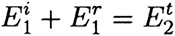
Boundary conditions at x = 0 require the continuity of the tangential components of the electromagnetic field. By denoting by , , the magnitudes of the tangential components of the electric fields, the boundary conditions at x = 0 imply

(2.298)

Figure 2.91: A wave coming from region 1 (x > 0) is partially reflected and partially transmitted into region 2, The incident, reflected and transmitted waves all lie in the plane of incidence, i.e. the plane defined by the incident wave vector and the normal to the interface between the two media.

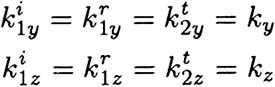
which must hold for all y and z. This can only occur if

(2.299)

and

(2.300)

Hence, satisfaction of the boundary conditions requires the phase-matching conditions (2.300) to hold,...

UNLIMITED FREE
ACCESS
TO THE WORLD'S BEST IDEAS

SUBMIT
Already a GlobalSpec user? Log in.

This is embarrasing...

An error occurred while processing the form. Please try again in a few minutes.

Customize Your GlobalSpec Experience

Category: Linear Polarizers
Finish!
Privacy Policy

This is embarrasing...

An error occurred while processing the form. Please try again in a few minutes.