Open Electromagnetic Waveguides

We have seen in the previous Chapter several examples of open waveguides and of their applications. It has been noted that a peculiar characteristic of open waveguides is to possess, apart from a few bound modes, a continuous spectrum. While, generally, the reader is quite familiar with the discrete spectrum of closed waveguides, as studied from basic e.m. courses [30], the notion of a continuous spectrum is relatively uncommon. In order to introduce the latter in a simple way, we refer in the following to the case of a parallel plate waveguide where we move one of the plates to infinity. By considering this example the properties of completeness and orthogonality for the continuous spectrum are introduced, also showing the analogy between discrete and continuous cases.
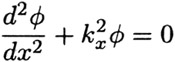
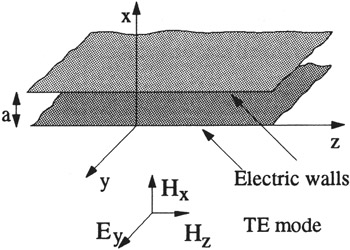
Let us consider a parallel plate region such as that shown in Figure 2.35 with a TE mode present. In this region E y = ? satisfies the equation
| (2.332) | ![]() |
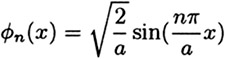
with the boundary conditions at x = 0, a (see Figure 2.35), requiring the vanishing of the tangential component of the electric field on the metallic planes, thus ? = 0. The solution of the above eigenvalue problem is, given by
| (2.333) | ![]() |
The normalisation constant in (2.333) has been chosen so that the mode set is normalised to unity; moreover the orthogonality is readily proved...