Open Electromagnetic Waveguides

This Chapter deals with planar dielectric waveguides, also called slab waveguides, which are possibly the most simple and yet practically useful open waveguides [6, 7, 8, 10]. In this introduction we briefly recall how a bound mode can occur; we also discuss why it is natural to look for the complete spectrum of slab waveguides and what features it should possess. These concepts are then considered in a more rigorous form later in the Chapter in Sections 3.2 and 3.3. In addition, in Section 3.4, the bound modes of slab waveguides are also introduced from a transverse resonance approach; whereas the continuous spectrum is derived from the relative transverse network.
A more complete understanding of the use of the modal spectra is obtained in Section 3.5 by studying the case of a field excited by a delta source. Finally, in Section 3.6, we consider the asymmetric three-layer waveguide which is a basic structure for practical integrated optics circuits.
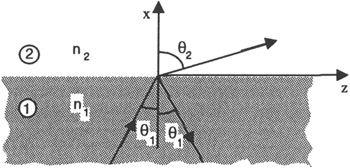
In order to introduce dielectric waveguides let us consider first the interface between two different media of refractive indices n 1 , n 2 from a simple ray optics point of view. We know from Snell's law that a ray impinging from region 1 on the interface between the two media (see Figure 3.1), is transmitted in region 2 with an angle ? 2 such that
| (3.1) | |
By assuming the medium 1...